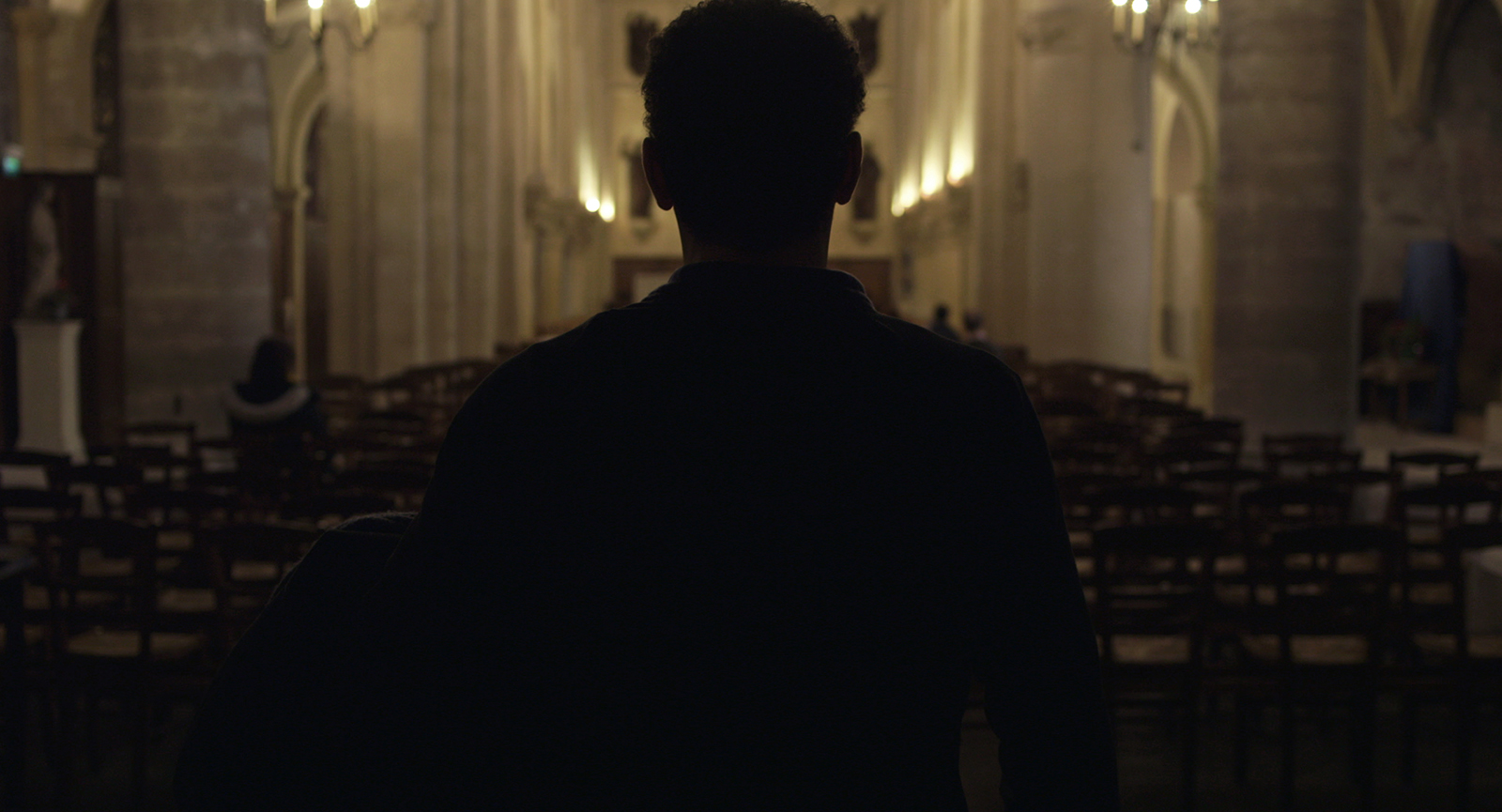
What astonishment overwhelmed me one recent morning as I listened to the voice of a young woman being interviewed by Louis Daufresne on his program, Le Grand Témoin , on Radio Notre-Dame. I was about to learn that this young woman's name was Cheyenne Carron. A Christian, she had made a film, L'Apôtre 1 , the story of a Muslim touched by grace who decides to convert to Catholicism and must endure the insults of his family.
Far removed from the constant stream of rumors and commentary the media forces us to endure all day, Cheyenne Carron's clear and composed voice captivates you. She answers questions if they are intelligent. She maintains Olympian calm in all circumstances. She wages a battle without violence. So few young women display such faith these days, in an era where violence has become commonplace, where violence has replaced struggle. We hear this voice that doesn't impose itself, yet commands respect—nothing arrogant, nothing weak-willed, a tranquil, serene voice. It's true that the magic of radio adds depth to the narrative. Cheyenne Carron's voice draws on a body of experience; she never flaunts it , but when necessary, she delivers it without embellishment. This body of experience is drawn from her short but intense life, which she developed almost unintentionally. A miserable childhood, before one was old enough to understand what misery was, forged a way of seeing life before one was even aware of it. When you listen to Cheyenne Carron, she is an open book. Accepting to make oneself an open book indicates having overcome fear. How does one overcome fear? I have often spoken of fear on this blog… But we quickly seem to go in circles when we talk about fear. Talking about fear is not frightening. Talking about fear is comforting. There is fear and then there is Fear. How far did God let Job suffer before he felt fear, true Fear? For Ernest Hello, fear exists in the Garden of Gethsemane. For Bernanos as well: “In a sense, you see, Fear is still the daughter of God, redeemed on the night of Good Friday. She is not a pretty sight—no!—sometimes mocked, sometimes cursed, rejected by all.” And yet, make no mistake: she is at the bedside of every dying person, she intercedes for humanity. Grace is never far from fear. One lies in wait while the other abounds. And vice versa. True fear is invisible. True fear is not shared. True fear is intimate. It speaks of each person's Good Friday.
From Cheyenne Carron's voice springs forth bravery. What's more, a bravery that has become second nature. Cheyenne Carron is brave because she has wanted to exist ever since she was abandoned shortly after her birth. She was then entrusted to a foster family who proved to be saintly; coming to find her in her misery, they showed her grace. Her very essence. Without grace, her bravery would not be bravery at all. Grace is the ally of faith; they go hand in hand and journey together to ease the conscience of the agony of every good Christian. Cheyenne Carron films as she lives. To speak of her bravery is to speak of the entire bravery of her film and its characters. In The Apostle , Fayçal Safi, the lead role of the Muslim who converts to Catholicism, demonstrates extraordinary talent . He demonstrates a life force. After all, to live represents fear par excellence, doesn't it? To live is to expose oneself, to acknowledge lack, incompleteness, and imperfection. All that imperfection we strive to hide. There is a stage in life, a simple and inaugural stage, which consists of no longer naming what one dislikes, but only what one loves. It seems futile and almost absurd: no longer acting against, but for. Acting for is another way of fighting. Acting for is equivalent to embracing fear. Because fear is embraced… It is possible to tell it that one loves it, that one cherishes it, and that one would never want to be separated from it for anything in the world. Akim (Fayçal Safi) shows in the film, at least twice, that he embraces his fear: when he is summoned by a family gathering worried about his detachment from Islam, and when two followers come to beat him. In these two episodes of the film, Akim embraces his fear, tenderly accepting it, and declares his faith in Jesus Christ. A monumental challenge. Facing him is either silence or violence, which amounts to the same thing. Akim moves in a different world, embracing his fear, transforming it into love, becoming brave. This is the metamorphosis of Good Friday.
What is most striking about the film, The Apostle , written, produced, and directed by a Catholic, and filmed with Arab-Muslim and Jewish actors, is its scope and balance. Because Cheyenne Carron puts everything into it and transforms it into a universal experience—isn't fear universal? Isn't bravery universal?—she compels everyone to undergo their own revolution . Who is Cheyenne Carron to order us to carry out our own revolution? A Pythia? A prophetess? An apostle, perhaps? Her film is a punch to the gut for Muslims, but also, perhaps even primarily, for Christians. And yet, it is the film of a committed artist who proclaims her Catholic faith. She always seems to remain neutral, even as she proclaims it. What a feat! This film renews the Christian ideal in our minds: it forces us to remember our shortcomings toward our neighbor. Isn't one of the most crucial questions the obligation to reflect on our own fault before that of our neighbor? Even if our fault is minimal compared to that of our neighbor. Even if? Especially if! Isn't this what separates us from all other religions? Christianity is not a religion that makes demands. Christianity is at the origin of all ideas of freedom and kindness toward our neighbor. All of them, without exception. Christianity invented the concept of the neighbor and embodied it through the figure of the Good Samaritan. It is conversion that is asked of us. Conversion in the other, in our neighbor, is conversion in myself, now. In other words: to be and to embody for our neighbor an apostle of Christ.
This conversion was brought about by watching the film The Apostle . A film by Cheyenne-Marie Carron.
- The Apostle is playing in two cinemas in Paris, the Lincoln and the 7 Parnassiens. Cheyenne-Marie Carron has no producer or distributor to finance her films. Who here will be surprised by the timidity and conformism of "the great family of French cinema"? Since May '68, French cinema has become a platform for the politically correct press, surviving on various and sundry subsidies that pass from one pocket to another, like an ode to cronyism.
The DVD of this rarely distributed film is available for purchase on Cheyenne -Marie Carron's website .
- All the actors in this film are amazing, and I hope you'll forgive me for only mentioning the main actor ↩
- In the sense that Thomas Molnar gave it, a complete return to the initial stage, but also knowing that one never returns to the initial stage quite the same ↩

Leave a comment