The life of Diego Armando Maradona is a fairy tale. Because Maradona always remained a child at heart. It is therefore a children's story, and as such, it is inspiring. Those who say that Maradona wasn't exemplary enough for an athlete of his caliber are wrong. It is the greatest modern exemplary story. It must be told again and again.
I accepted the unacceptable: I became an adult.
Thus began my expulsion from the present.
Octavio Paz
The Neapolitans are today a large tribe…
who decided to die out, rejecting the new power,
that is to say what we call history, or the
modernity… It is a refusal, stemming from the heart of the
community (we are familiar with mass suicides)
(in herds of animals); a fatal negation
against which there is nothing to be done. It provokes
a profound melancholy, like all tragedies
which are accomplished slowly; but also, a profound
consolation, because this refusal, this denial of
The stories are true, they are sacrosanct.
Pier Paolo Pasolini
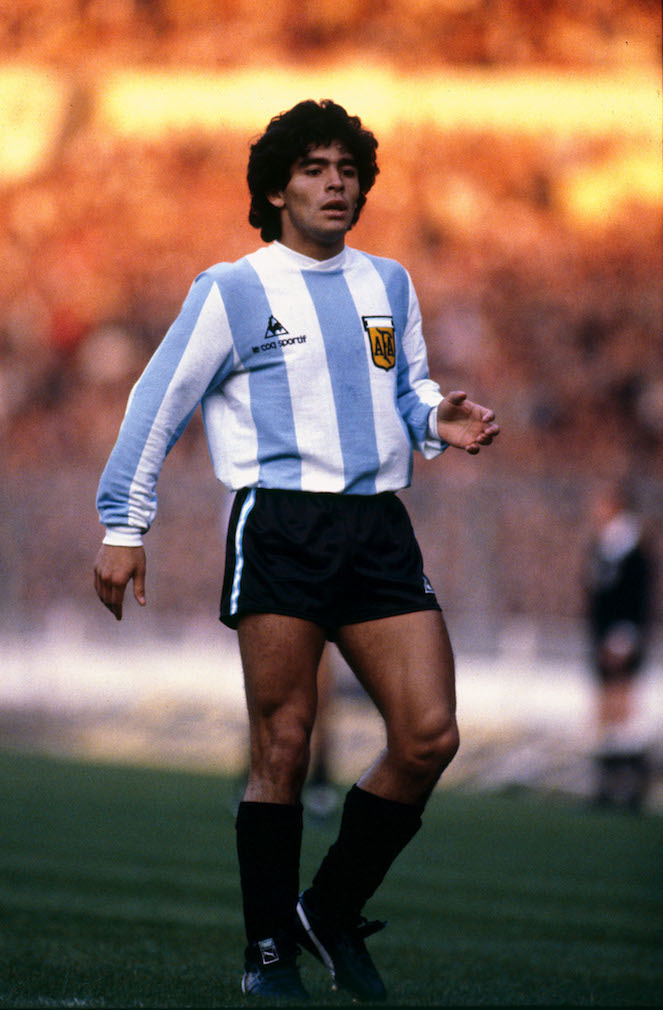
Diego Maradona
Ardor, ardor, my heart, I was never made for introspection. What I wanted was to always move forward, into the night, into the revelry of the night, and into the joy of Sunday when the San Paolo stadium vibrated, when the Neapolitans were shouting themselves hoarse. I could have heard their cries deep in a cave if I had been locked away at the very bottom of Vesuvius. Their cries would have brought down the majestic, the great, the impossible Vesuvius, he who had fallen silent because when I arrived here, I arrived by air, and already, yes, already, I knew. I said, "Ardor, my heart," and there they were, eighty thousand waiting for me. And there I saw him, he turned green with rage. No one had ever inflicted such a humiliation upon him, no one had mocked him in public like that. No one had ever set foot near him and said, "Now you are no longer the only wonder of this place." I said, "Starting today, I am building my empire in this place," and the eighty thousand Neapolitans who filled the San Paolo stadium said
Here he will build his empire, and we will be that empire
They had never said that, they had never believed themselves so strong, they had never faced the North and its pride, its money, its industrialization, its arrogance, and they said it, shouted it, repeated it endlessly. They knew they could believe it, that a dream was coming true. And I arrived by air. I thought the Iberian Peninsula was made for me, but there they hadn't believed me, oh no, they hadn't believed me. I love the Iberians, I speak their language, I played there in a dominated country. How could the slave become the master of the exploiter? I asked myself the question, oh not for long, because I was pushing my heart. I had failed among the Iberians, but there I was among the rich, I was among the Catalans. They have millions and millions of pesetas. I had no cause to defend. They thought they had everything. What could I give them? What could I offer them? You can only offer the spirit. The Catalans thought they could buy it, but I used it as a banner. The spirit is something, no, it's not a signature at the bottom of a contract, it's not smoke and mirrors, it's a poem. It's worthless, but no billionaire can afford it. Well, that's it. When I took off from Barcelona, when I turned my back on Nuñez and all his dollars and pesetas, I told myself, "Ardor, my heart, there you will build your empire, and until the end of time, you will be adored for what you accomplished at the foot of Vesuvius in the Parthenopean city." So I left with a light heart, and in the helicopter, I remembered that promise an opposing player had made to me after I had just lost five goals to zero. Oh my God, I remember that day as if it were yesterday. He came up to me at the end of the match and he said..
Don't worry, one day you'll be the greatest player anyone has ever seen on a field
Of course, at that time I knew nothing. It had pleased me, of course, but I had lost and I never wanted it again. He was a head taller than me, and he had told me, "You will be the greatest player anyone has ever seen." So I went back to Villa Fiorito, and Dona Tota, Mamita, the one without whom none of this would have happened, well, Dona Tota looked at me, all filthy, covered in mud, with tears in her eyes, and I told her what the other boy had said. And she said, "Really, only your mother would say something like that and believe it." She said, "It's true, one day you will be the greatest player in the world." Then she put her hand on my cheek, brushed off some of the dirt that must have seemed too much on my face, which was already made up, and she said, "Pelusa" ( she always called me that because of my mop of curly hair), "Pelusa, you will train and become the greatest." The greatest player the world has ever known—well, believe it or not, I did, and that's why I say, "Ardor, my heart," because I feel that the seventy thousand Neapolitans gathered in this San Paolo stadium believe it too.
And I want the world to believe it
Up until Barcelona, everything had been very quick and easy, but after leaving Catalonia, I had some time to realize that the path that had seemed so clearly laid out before me—for as long as I can remember, let's say forever—would encounter some unforeseen difficulties. All because, ever since I could walk, I'd been following a ball. At first, it was a small ball of rags tied together. Then I got my first ball; it was all mine. I was three years old. I slept with it all night, tracing arabesques in my dreams, unstoppable dribbles, incredible goals. Everything happened so fast; I remember it like it was yesterday. All my friends from Villa Fiorito, that sad, gray shantytown on the outskirts of Buenos Aires, but nothing was sad or gray for me. I'd take the ball and play with it, juggling until I was breathless. When I was nine years old—yes, I remember, I was nine—a man walked past our house and said, "How many..." You can juggle without the ball touching the ground. I looked at him and told him there were no limits, that he was the one who set the limits. So he suggested I juggle at halftime of the local team's matches. I ran to Dona Tota because it was Mom who decided, and she said okay, you want to show what you can do. Dona Tota knew very well that what I wanted more than anything was to touch, to caress that ball that I couldn't let go of. So she said okay, and the following Sunday I stepped onto the field. There were thousands of people following the exploits of their team. I was just a little boy of nine years old. We hadn't yet entered the seventies, and my team was called Los Cebollitas ? I remember it like it was yesterday. Oh, I know it will sound silly to some, but who else but me has been so loved and so hated? Whatever I've done, there have always been people who resent me, who don't understand my simplest actions. But me, oh, if only they knew, if only they could understand that for me, nothing is more important than the game, the game of the ball, football. Of course, they'll talk about my world being saturated by the ball, but if I look them in the eyes, they're the ones who look away. They're the ones who are wrong to judge me, and I'm sure they know it because, how can I put it, I'm sure they feel it. That I haven't deserved their hatred to this extent, that this hatred only exists because they're jealous. Jealous, there's nothing else to say. Well, I say they have no reason to be jealous because they don't realize what it's like to... to be born in this small house in Villa Fiorito in such a poor neighborhood and they don't imagine what it's like to grow up in such a small house, the size of a bathroom, with two brothers and five sisters, they don't know, oh no, they have no idea. Those who judge are those who have never known poverty. So I see the eyes of this man, a tall and well-dressed man. I see those eyes. I had already seen him pass by in the street and stop to look at me. I raise my head and he says to me, "Would you like to show what you can do?" So I say, after asking Dona Tota, "But of course." And he asks me, "What's your name?" And I tell him, "Diego el Niño de Oro ?" I wanted to add, "Remember that name," but I saw in his eyes that it wasn't necessary for him to remember it, that he would always remember it. So the following Sunday, he came to get us: Dona Tota, Papa Diego, and my brothers and sisters. He paid for everyone's bus fare, and we went to the stadium. There, he settled my family in the stands, and for me, he led me through an underpass. I passed players and coaches; they all had beautiful equipment. He gave me new shoes, a jersey, and shorts, and he said, "These are yours, Pelusa." Dona Tota told him what she called me, my nickname, and he pushed me from behind. I was carrying my ball, a brand-new ball he had given me, under my arm. I moved forward and felt the crowd, thousands of people who didn't understand. I didn't understand everything either. Thousands of people laughing and joking, or sad at the Halftime, because their team was winning or losing, thousands of people who normally wait impatiently for halftime to end to see their team battle it out, well, these thousands of brave Argentinians saw a little something appear on the empty field. The field was all mine; I didn't have to share it with my teammates, I didn't have to share it with the opposing players, I didn't have to share it with the referees. I just had a few minutes to show what I could do, and I heard the announcer say, "Here is El Niño de Oro, the king of juggling!" And I put the ball down, and the announcer was finishing his sentence when I thought to myself, "They don't remember my name; they just heard it; they've forgotten it." I thought, "They have to say my name; they have to remember it." So I put the ball down and picked it up with my left foot and juggled it almost a thousand times. If they had let me, I would have... I juggled for every spectator, but halftime was over, so I took my ball and went back to the locker room. When I left the pitch, I looked for Dona Tota, but I couldn't find her; there were too many people. I saw the players from the other teams waiting on the sidelines, watching me, and I knew they were all starting to call my name. That's when I knew, and I was happy because they were happy too. It was a time when I dreamed of being an idol like Rojitas, the star of Boca Juniors, or Pavoni. I dreamed, but certainly not of reaching such heights. But I think the people who were there knew that I would go even further, and the man who had asked me to come knew it too. He took my hand and suggested I come back the following Sunday. I almost said yes right away, and then I remembered that I had to ask Dona Tota because without Mamita, none of this was possible. I needed her permission. Dona Tota wanted everything for her son; she wanted him to have the very best, and even that wasn't enough. Finally, she said yes, a firm yes, to the man who kept repeating my name as if it were that of a Catholic saint. He kept repeating my name, and I had the impression of a whisper that grew louder and louder. Tota, but also Papa Diego, whom we nicknamed Chitoro, always protected me. I always wanted them close to me, and I always wanted to protect them when I had the means, so that they too could have the very best, like my brothers and sisters, like my wife Claudia, like all my friends, my many friends, those for whom I would never have failed. I am always loyal to them, even though I always read the same allegations about my clan in the press. But they don't understand anything, all those journalists. They never understood anything. The clan, as they called it, was nothing more than my family and my friends, and I am only happy with people that I love around me, and what did these journalists hope for, I ask you, what did they hope for if not to unite us a little more with each of their attacks? But they were wrong because despite the billions I earned, I didn't change, and my relationships with my friends didn't change either. The journalists were wrong, even if they were right, they were wrong because my friends and I were made of the same stuff. I knew almost all of them in Villa Fiorito; we got up to the same mischief together. So when I have a moment, I think of them or I get closer to them because you mustn't forget where you come from. This tribe was my refuge. Anyone who has never known exile can't understand because exile is hard and it's long like an endless winter. My tribe protected me from the excessive adulation I was subjected to. In fact, I see clearly now the only fear I've ever had, but it's a fear that is in Part of me is the fear of being alone. You can be cheered by tens of thousands of people, you can be adored by millions of kids, but you're still alone at night after the match when you go home. So I didn't want to be alone. I wanted to be in Villa Fiorito like in the beginning, when the man came and asked me, "Do you want to show the world what you can do?" I wanted to be with my family, to enjoy an asado, and to take refuge, to snuggle in Dona Tota's arms and kiss her. I had to fight against nostalgia and respect where I come from. People can criticize me for it, but those who don't understand have no heart. Oh, how many journalists have hearts! You can always say what you want, but I am one of the good people, and I will always fight for them. I remember that many years later, Marciano Grondona, a star of Argentine television and a famous sociologist, said about me.
The outside world is divided into a minority of politicians, journalists, and leaders who want to use him, and the people—he feels he belongs to the people
And people, it's not that damn Nuñez who made me waste two years in Barcelona. Oh my God, what an experience those two years in Barcelona were! I'm so glad I got out of it. That's what it means to get out, like coming out of a tunnel or a cave where I was held against my will. It's not Barcelona or the Catalans who are to blame. They gave me so much, and I regret only giving back a few crumbs. I guess Spain, and especially Barcelona, just wasn't for me. How can I put it? When the vibes are negative, you shouldn't push it. That's it, you shouldn't push it, you have to get out of there as fast as possible. Tally-ho, tally-ho! I think it's fair to say I fled Barcelona. Nuñez and his crony Gaspard—oh my God, the president of FC Barcelona and his assistant! What a nightmare those two were! Even if it's true, I admit it, who said, "Finally, yes, I admit it, this transfer to Barcelona." It almost made me lose my mind. I can still see Francisco's face, the receptionist at the Avenida Palace where I stayed when I arrived. I remember when he saw me and my family arrive in the marble lobby of his luxurious hotel. He'd never seen anything like it. I was worse than a rock star, my head was spinning, caught in a vice. I only felt comfortable on the field. I was only 21 years old, I came from Villa Fiorito, and I didn't know any manners. Oh, for sure, I drove them crazy, but they all had to understand, these fine gentlemen. Oh yes, they had to understand something: luxury. I laughed in its face. Wealth? I slapped it, slapped it by being even more opulent than it. It was a rivalry, that's what you have to understand. Wealth is insolent for a kid from Villa Fiorito, so I had to be even more insolent than it, to appropriate it. It had never existed except for me, for me to use and make the most of. It was the summer of 1982, and oh yes, I should have known better. Barcelona wasn't for me. My young and precocious reputation had just suffered its first blow. I had just played in the World Cup with Argentina, and oh, it was all too much for me. Where had the fun of the Villa Fiorito pitches gone? The frenzied matches with the Cebollitas that I'll never forget, with Argentinos Juniors where we spent our time trying not to be relegated to the second division? That's perhaps where I achieved the most. My God, the number of feats I accomplished in that red jersey! And then there was Boca Juniors, the greatest Argentine club, and the championship title—the first, no, the second! Before that, there had been the magnificent Junior World Championship in Japan. Oh my God, how far away it all seems now, while I'm flying over the Mediterranean to reach Naples. Everything is so... Far away, and the game, what remains of the game? One day, Luis-César Menotti, who first selected me to play for Argentina, I was 16 years old. My God, how far away it all seems. I was 16 years old and I wore the blue and white jersey of the Argentine national team. Me, El Niño de Oro, nothing could be more normal, I thought then. Nothing could be more normal, everything had happened so fast. A year earlier, I had played my first game in the Argentine first division. I was the Mozart of football, I was Rimbaud, I was God, and God doesn't like those he chooses to think they are stronger than him. That's what he wanted me to understand, perhaps. And then there was that break, the first, perhaps the hardest to bear, when Menotti called me. Menotti, do they call him El Flaco ? Because he's tall and long like a cigar. Menotti calls me and says
Nino, you're 17 years old, you have a long career ahead of you, you're a prodigious player and you'll play in many more World Cups
He was right, of course, time has proven him right. He was right, but he was wrong. I still carry an eternal ache, a wound that will never heal, from having to leave the team's preparation and from having experienced that World Cup, that 1978 World Cup, our World Cup, as a spectator in front of the television I had just bought in Tota. And at the stadium for the final, I had prepared my papellitos, those little slips of paper where we Argentinians write words of love for the players and that we throw from the stands. I was sad. It was the second time I had cried because of football. The first was after losing with the Cebollitas. When that young boy came to tell me that one day I would be the greatest player in the world, I cried and I thought back to that other day. Several months earlier, I had been juggling at halftime of matches, and a TV crew had come to film me. The journalist came close to me, very close to me, with his big microphone. asked me
Tell me, little prodigy, do you have a dream?
I told him I have two dreams: the first is to play in the World Cup, and the second is to win it. The journalist was speechless, but he too would remember my name. I have two dreams: to play in the World Cup and to win it. I'll need two World Cups to realize these dreams. I have even more dreams, and I'll have more. My head is always full of dreams. Oh, how I would have loved to play alongside Kempes and Luque! I couldn't bring myself to be angry with Menotti. He had made my country win. It was the first World Cup we had ever won, and we breathed easier in the streets of Buenos Aires, despite the military junta and Colonel Videla who held us in his iron grip. It gave us Argentinians a little air, it gave us oxygen, and we were very proud to have won that title. But I was still left wanting more. So Menotti, who loved me like a son—I know it now, I always knew it—Menotti He loved me like a son and gave me a platform and an audience, and he told me, "Now show us what you can do." That was in Tokyo the following year. That under-21 team was by far the best team I've ever played on. It was extraordinary. We arrived in Japan determined to do as well as our seniors had a year earlier, and what a performance! We gave six matches, six wins, 20 goals to our advantage and only 2 against. I was named best player, and Ramon Diaz was top scorer, just ahead of me. The best team I've ever played on, by far. Gabriel Calderon Carabelli, Ramon Diaz—I remember every player who made it up. What a team! Tokyo was truly the fulfillment of a dream, but I already saw other challenges ahead. After that, I went to play for Boca Juniors several times. I rocked the Bombonera — our legendary stadium. Sixty thousand fans shouted my name and sang in unison, "Diego Diego!" Just remembering it gives me chills. Anyone who hasn't experienced that can't understand what it feels like to score a goal and have the stadium erupt in celebration, the connection that forms between the player and the crowd. I was twenty years old and the idol of a nation. I was twenty years old and the center of the world, because for me, the center of the world was a ball. Sixty thousand spectators chanting your name—that's enough to make anyone lose their head, not to mention the thousands more in front of their televisions, not to mention the articles calling me the new Pelé, not to mention the thousands of dollars that allowed us to leave Villa Fiorito and live—my brothers and sisters, Dona Tota, Don Diego, and me—in an apartment that seemed so luxurious compared to Villa Fiorito. And since I love being surrounded by those I love—oh yes, I love being near those I love—well, I had given apartments to Don Diego's friends who were still living in Esquina, another poor suburb. From Buenos Aires, and especially Rodolfo Gonzalez, that young deaf-mute man who would spend hours watching me dribble the ball—all those people, yes, people, not powerful people, people like me, except that I had a gift for football, that thanks to it I earned a lot of money, and that's how I brought joy to those I loved. Tota always said, when you have money, you share it with your family, so that's what I did, and I did it well anyway. No one can tell me what to do, and then there's my family, my friends, they're the ones who surrounded me the day Menotti told me, "Nino, you're 17, you have a long career ahead of you, you're a prodigious player, and you'll play in many more World Cups," and I'm grateful to them for that because without them I wouldn't have made it. I cried so much, I wanted my revenge so badly. So when Japan came, when I won the Junior World Cup, it wasn't revenge, no, no, it wasn't revenge when I The stadium lit up, and all the TV stations around the world started saying my name. They all said Diego, yes, that's it, they all said it like a prayer, Diego. So I said, "It's me, I'm El Niño, I'm Pelusa, I'm Diego." And even I, at that moment, felt the joy I was giving to others. And then Menotti's words came back to me: "Nino, you're 17 years old, you have a long career ahead of you, you're a prodigious player, and you'll play in many more World Cups." So then I thought to myself, "And I'm going to win, yes, I'm going to win so that the world keeps repeating Diego." It was like a drug. So Japan wasn't about revenge, no, no. When I raised the trophy with Simon Diaz and Calderon, I told myself, "This is just the beginning, it's not my revenge, not yet." Because when the journalist approached me with his big microphone and asked me, "I was nine years old," I wasn't laughing. I was nine years old, and I was alone. Maybe it was just me and the ball, my ball. Back then, I didn't know what loneliness was. I was serious, and I was alone. So the journalist said, "Tell me, little prodigy, do you have a dream?" I answered, "I have two. The first is to play in the World Cup, the second is to win it." And I was so serious that the journalist was speechless. And now, I've never seen him again, but I know that in the stadium or in front of his TV, that journalist repeats my name tirelessly. I'm sure it's his drug too. And he says, "This little prodigy, I know him. I was the first to interview him. He's called El Niño de Oro, and he invents goals that come from nowhere." So after that, I didn't want to be alone anymore because that kid on that field, sorry, he was alone with his ball, with no one to talk to. And that's why I didn't want to be alone anymore. I wanted my family and my friends, my tribe around me, so I wouldn't... No longer being alone because I already carried a lot of responsibility. My price was exorbitant for the time; now it would be laughable. Now I'd be worth 1 billion francs, and nobody can understand that, especially not journalists, especially not that French journalist who came to see me in Barcelona in 1982. He asked me if I thought I was worth 8 million dollars. He asked me that! I wasn't laughing, I was serious. I told him I was worth much more than that, much more than 8 million dollars. So he laughed, and in his commentary, he said I was pretentious, that idiot! Of course, a man is worth much more than 8 million dollars, but he couldn't understand that. That's when I understood that with journalists, I would always be alone, always alone, in fact, now that I think about it. Yes, now, as I approach Vesuvius in the air, I can think calmly. Well, yes, my problem is that I'm still alone. Between 1979, the year of my victory in the Youth World Cup, and 1984, the year I left Barcelona, I must have had three bouts of depression. I don't know, but yes, I know very well, I don't know. So, if you can imagine what my life is like, it's true that everything started well. It's true that the world of football was at my feet, but what is all that? I have a family I love, a fiancée Claudia whom I adore, who is truly, and despite everything, my safe haven. She's the one I love, and it's to her that I always return. She's the only one who understands me. I have friends with whom I share wild nights, but we are South Americans after all, and we live in exile. Yes, exile. For a South American, already exiled in his very being by his dual belonging to a different culture and nature, exiled in his mind, we need the night to live even faster, even more intensely. I know it's difficult for Europeans, who are clean and neat and settled by nature, to understand, but we live to the rhythm of the Samba, tango, we need the night and its delights to accept the everyday. Is all this so difficult to understand? But what did they hope for in the end? What did they believe by bringing me here? That I was going to make them win? I tried. I would have liked it. The Barcelona fans had seen my goals with Boca and the Argentinian national team, like that Barcelona fan who guarded my goal against Estudiantes La Plata like a relic. Ah, that goal, I remember it like it was yesterday. That long pass from my teammate along the touchline, that opponent approaching, me arriving near the corner flag. The goal is far, far to my left, and bam, with a magic kick, a prodigious diagonal, I lob the keeper from thirty meters. Ah, nobody expected that, nobody. I was so fast. It's like that Russian who marked me in the Junior World Cup final. The first ball I receive is at mid-height, I feel my bodyguard. He's approaching me from behind at full speed. I receive the ball, I cushion it with my chest while turning it so it comes in front of me. The Russian arrives, I don't let the ball hit the ground and I lob the Russian, who continues his run into the void. By the time he realizes and turns around, I've controlled the ball and I'm already far ahead. Some say I was reinventing football. For now, I was just going too fast, but in fact, there were many great players: Platini, Zico, Rummenigge. Before them, there was Pelé. All these players were great, but I was unique. Yes, that's it, unique. I know people will say I'm pretentious, but if you watch other players, you can guess what they're going to do. That they do it very well is another issue that no one discusses here. You know what they're going to do and you applaud when they do it, bravo, bravo! Me, you never know what I'm going to do, simply because I don't know myself. You tell me... You'll say, "And Pelé?" As for Pelé, I'll answer later. All these memories will have taken a different turn. I won't forget because I can remember everything. I'm in the air. I love being in the air. It's going to sound pretentious again, but in the air, I feel like I belong. Besides, oh, I don't know if I should admit this. I should, of course I should. In life, there are so many things to say and do that it's normal to lose your head from time to time. Well, okay, let's go. I'm going to tell you something that has always worried me, something that is at the heart of my existence and that I never talk about to anyone. Something, my obsession, the place where I'm afraid: my shadow. When I was alone on the abandoned pitch at Villa Fiorito, I tried to escape my shadow. My extraordinary goals served only that purpose: to defy my shadow. You have no idea what it's like. No, you have no idea. My shadow always brings me back. on earth, while I feel at home in the air, so as soon as I score a goal, I leap, I jump to regain my sphere, my heights, and I slam my fist into the sky with the rage of having managed to break free from this mundane aspect of my existence, this shadow that clings to me and forces me, off the field, to be a man like you and me—that is to say, what I do least well. And that's normal; who can dine with God and then go down to sleep in a concierge's lodge? Has anyone ever understood that each of my goals was an intimate dialogue with God? So, obviously, I needed my tribe so I wouldn't be alone when I came back down to earth, and these people around me—my family, my friends, these women, these endless parties, these stimulants, these euphoric things—were only there to allow me to find myself again in rare moments. And since they were rare, I had to start all over again to find that freshness, that oxygen, just to rediscover, in rare moments, the unique magic I had known with the ball, with the Spectators with God, but no one can imagine what I felt when I no longer had God to talk to. I felt so alone, and this shadow clung to me. Then a magnificent encounter began to take shape: my revenge. Yes, it had to be my revenge, the revenge of 1978 when Luis-César Menotti came to see me and told me I had many World Cups to play in. It was 1982, I was 22 years old, and I was going to show the world, even the last skeptics, what the Golden Boy was all about. I was going to play in the World Cup in Spain with the best team Argentina had ever had: the 1978 winners with the 1979 juniors. We were so strong, unfortunately, in football as in life. I know that now: you have to be hungry. I was always hungry because if you had been born in Villa Fiorito, in such a shantytown, you would always be hungry. But the others, this team, they were no longer hungry, and that is unforgivable. We had too much. We had confidence in ourselves, and right from the first match, in Barcelona, we were brought down to earth against Belgium. I remember that coach, that unassuming old man, Guy Thys, a funny, incredibly intelligent guy. He put a kind of padlock around me—yes, that's it, a padlock. There were four or five of them, all over me, and they stifled my game. What a strange memory! I never felt like I was playing that game; it was very strange. And we lost one-nil. Really strange, but we were the reigning champions, and like good Argentinians, we rebelled. Sometimes Europeans have trouble grasping the Argentinian character, which is all pride and nobility. The poor Hungarians, who wanted to repeat the Belgians' feat, didn't understand it at all. That day, I gave a recital, just like at Boca Juniors or with the Cebollitas. We played an extraordinary match. In the next match against El Salvador, there were a lot of fouls against me, but we won. The hardest part was just beginning because Argentina was playing against Italy, and Brazil in the qualifying matches, that's where I felt the most alone. It was the first time God wasn't with me on a football pitch. He wasn't there because he was disgusted by an Italian player, the biggest cheat I've ever known: Claudio Gentile. Italy had played very badly in the first round; they had almost been eliminated by Cameroon, and against us, they decided to have me marked tightly by Claudio Gentile. "Closely marked" is an expression used in football to mean that the opponent is glued to you, and Gentile was glued to me more than my own shadow, because my shadow never trips me, oh no, that would be the last straw! If there had been a referee on the pitch, Gentile wouldn't have finished the game. People say I cheated sometimes, and they're right to say it. I have been a disbeliever at times, rarely, but it has happened. We'll talk about it again, but never, ever do they take into account... I had to endure all sorts of cheaters, not to mention those who attacked my integrity. Claudio Gentile must have committed about thirty direct fouls against me. I was never able to develop my game. Argentina lost again. The next match against Brazil was do or die; we absolutely had to win. We dominated a good part of the match, but after the first Brazilian goal, I remember that free kick from Eder, a forty-meter missile that bounced off the crossbar and was headed in by Zico. The referee should have given me a penalty because Junior fouled me in the box, and nothing happened. The referees weren't very good back then, and it's a real shame that the game suffers because of it. So at the end of the match, I was more alone than I've ever been, so alone. Oh my God, I remember those images so well. Batista fouled Kempes, and I saw red. I really saw red. I jumped, foot first, and the Brazilian player doubled over. I wanted I wondered if there were referees at that World Cup. I was taken like a child tasting the jam his mother saves for special occasions. The referee pulled out the red card. Me, El Niño de Oro, who had come to conquer the world, I slipped out through a trapdoor. I stood there with my arm raised after my foul. I cried after the referee brandished the punishment. I crossed myself and left the field. I cried, and thousands of spectators cried, and I told myself I would have my revenge. Perhaps it was then that I understood that my life was a story of revenge, of exclusions and exploits, of light and shadow. I don't know if it was there that I was excluded; that's all I know. It was the first and last time I was excluded from the national team because after that I never wanted to be alone again, and that's also why God made me play so well. That's why I I always made the sign of the cross when I entered or left the field. If I hadn't, yes, I would have felt like I was betraying him. And God, with the gifts he had given me, I can say it, yes, I can say it, God was a little bit part of my clan. But then I didn't yet know that in Barcelona there was a man who thought he was God, José Luis Núñez, the president. He thought he was God. And while I was leaving Spain through the back door, I would soon return through the front door. Barcelona awaited me; the long-awaited transfer was happening. So I took Tota Chirito and my whole tribe to Barcelona. Another life was beginning. So when the doorman of the Avenida Palace saw my tribe and me arrive, he was afraid. He had seen kings, presidents, movie stars, and rock stars come to his hotel, but he hadn't seen me or my tribe yet. I arrived like a prince, ready to conquer the world, and I wanted everyone to know it. I would be criticized for it for a long time. All of that is in the past now, and I I can speak freely about it. When I arrived in the marble lobby of the Avenida Palace, everyone was at my feet. For four months I lived there; I had commandeered the first floor. In fact, what I hadn't seen at the beginning, but I see now—yes, now it all seems clear, limpid, crystalline—is that I was in a turmoil. The business world was grabbing hold of me and would never let me go. After that, I signed my contract on June 4, 1982. No Argentinian had been so eagerly awaited in Spain since Evita Perón when she visited Franco in 1947. I was the messiah for some, the man to be taken down for others, and all this hatred and love were amplified tenfold by the fact that I belonged to FC Barcelona and to Nuñez, the megalomaniac. Ah, it's certain that our two personalities had little chance of getting along. I began, by meeting Nuñez, the great struggle of my life, the one that would permeate my entire life: the struggle against The powerful of this world, who consider players, or even human beings in general, as mere commodities, I unwittingly ushered in the era of victorious capitalism in sports, where only the rich enjoy the material benefits of life. I was in the eye of the storm, in the calm, when no sound could be heard, just before the fury of the tempest swept everything away. By signing my contract, I was making a pact with those I hated most, the powerful, and turning my back on those I loved most: the people, the common folk. But I didn't know it. I was young, I was a wild dog. I thought I could solve everything on the pitch, but there in Barcelona, even the pitch would betray me. That was one of the most terrible moments of my life, those two years in Barcelona. The best player in the world arrived at the best club in the world, a paradisiacal vision if ever there was one. But no, I belonged to the people, not the management. So we entered a great period of misunderstanding. Barça Boca Juniors is one of the most powerful clubs in the world, boasting 110,000 season ticket holders and over 1,000 fan clubs from Beijing to the United States. Its facilities would make Boca Juniors look like an amateur club. The Nou Camp is a legendary stadium, a cathedral of football. Núñez, its president, was born in the Basque Country, and my encounters with Basques in Spain were always delicate. He runs the club as if it were a personal triumph; no one can meet his gaze. He only believed in two things: discipline and success. What a disaster! What a misunderstanding! Everything had started so well. Yet, on July 28, 1982, I entered the Nou Camp to be presented with my teammates to the public. I told myself, "This is the moment of truth. I didn't come here for my own glory, but for the glory of the team, because I can't win matches alone. That's why I hope we will stick together and become Spanish champions." I realize now that we talk a lot when we're young, and with all these microphones that... They lined up right under my nose, I was tempted to say more than I should have. My teammates were really great guys. Little by little, I became friends with some of them, like Schuster or Carrasco, with whom I shared a room. He was a funny guy, really nice. He was very talented and he managed to imitate what I did in training. When people asked him what he thought of me, he would answer
I'm impressed by his humility; he's a very humane person. In Argentina, he's considered a demigod, but he's never forgotten where he comes from, his roots, his poverty. He made me realize how hard he had to fight to get where he is and how concerned he is about his family's well-being. He wants them to be safe. He's full of dreams; he's so innocent and so eager to succeed. The more I became friends with him, the more worried I was about him. I was afraid that all the passion that drives him might betray him
I was a mad dog, a rabid dog, but as soon as I stepped onto the pitch I became someone else. All the teammates I had throughout my career were aware of this, which is why they all respected me. And Carrasco said of me..
He's like a chameleon on the pitch. Diego is transformed; he's so confident. He's not the same man anymore. He seems to have total control of the ball when he runs with it and starts dribbling past opposing defenses. All the players around him seem tied down, unable to move. During our training sessions, we just want to be by his side and watch him shine. We just want to witness what he's capable of
Another man supported me: Nicolas Casaus, the vice-president of Barça, who had spotted me in Argentina. He was like a father figure to me in sports. But compared to all the people who wished me harm, it was nothing. Yet everything had started so well with Schuster. We understood each other immediately on the pitch. The first match at the Nou Camp was a festival. We were playing Zaragoza. One free kick, two assists, 3-0. I conjured magic with my left foot. The Nou Camp and its 120,000 spectators were at my feet. But very quickly, Spanish football showed its true face: violence. I couldn't play anymore. And since Spanish television was the worst in the world, violent players were never punished. I was already fed up with the authoritarian methods of our coach, Udo Lattek. He drank more beer than an army, and with him, it really was an army. A real dictator, that coach. He wanted us dead, I'm sure of it. I had just arrived from South America and was discovering war. futbol de muerte ? Incredible, not a Sunday goes by without someone threatening my physical safety. Luckily, there was the European Cup, like that day when everything went well. I remember it was October 20th. We went to play in Belgrade. Red Star was a great team in Europe. Schuster and I demolished them. Images of our play went viral. The Serbian players, certainly among the best in Europe technically, spent half the game watching us play. I scored two goals, including an extraordinary lob. 4-2. The Yugoslavs, who are remarkable football connoisseurs, gave us a standing ovation for over a minute at the end of the match. When we played at our level, we were irresistible, irresistible. I enjoyed playing. At the end of training, Lattek would ask me, "What are you doing, Diego?" and I would run around the pitch collecting the balls. Lattek would yell at me, "We pay people to do this!" But I kept going because it amused me. Because people knew me, "El Niño de Oro" as they nicknamed me, I was aware that FC Barcelona wasn't like other clubs; many had failed here and few had succeeded. Carrasco told me
Be careful when you go out on Monday and Tuesday evenings, that's fine, but if you go out on Friday before a match, be very careful because the media can destroy you
But I wasn't very careful, I never have been. El Niño de Oro doesn't have to be careful, he takes risks, he's not afraid, and at night my shadow disappears. At night Pelusa doesn't need to shine at night, I'm myself, just like on the pitch, not the same me. I know it's hard for a European to understand, but that's how I am. I injured my thigh after a month and the troubles started. I hired a personal trainer, Fernando Signorini, and I wanted to treat myself. Everything was so hard. I didn't trust the people around me. My family, yes; my teammates, yes; but not the Barcelona management or the staff. I always felt animosity towards me. After all, I was just a Sudaca ? As they condescendingly say, a sudaca, and when I played again—I played very little, I caught a virus, hepatitis, which kept me bedridden. I spent Christmas with Tota all alone, far from Argentina, from Claudia, and from the world I came from. It was one of the hardest times of my life. I was settled in my Hollywood villa in Pedrales, so very quickly I moved my whole group of friends there, the ones I'd grown up with in Villa Fiorito. I helped a friend of Argentinos Junior, Oswaldo Buona, join a club in the Spanish second division. He lived with us, and also Ricardo Ayala, who had been abandoned by his parents as a child. He lived in Esquina, the suburb of Papa Chirito. I took him in, and he became my driver. I remember when we used to fish together, along with many others. That way, I was less alone and I could more easily bear the sarcasm and contempt of the Catalans, locked away in my palace with my Friends with them, no representation problems, I was myself. It was during this time that I started going out a lot with all my friends. We started going out and experiencing Barcelona nights. On Sundays and Mondays, we were at all the parties, just like in Buenos Aires. In Pedrales, I had managed to create a world, a microcosmic Buenos Aires. As for Jorge Cyterszpiler, my childhood friend, he ran the company that bore my name and handled my image, and he maintained the last link with Barça. From afar, I heard Casaus complaining; he was disappointed. He saw me less in the press, he said one day.
I'm worried to see him losing his way; he's changed. He's like a tree that needs a stake to grow straight. It's not a sporting failure, but a human one. We can't talk to him anymore; his family and friends have built a wall around him
I explained to him that I needed protection, but all those managers wanted me for themselves, they wanted to manipulate me as they pleased. But I was slipping away from them, escaping. We were going out more and more, and I wanted to feel alive. I wanted to avoid falling into a depression. I kept going out. Why did I feel so alone? Who can tell me? I can't. It was during this time that I tried cocaine. I was always alone. The field could no longer give me satisfaction since I wasn't playing anymore because of injuries and viruses. And off the field, I was like a terminally ill patient. Many of us were taking drugs, many other players too, but only to escape this shadow that was far too pervasive in our lives. It was necessary to live a little longer. It only happened to me a few times. It isolated me even more, but I thought I could never be harmed. I was filled with this certainty: God had chosen me, and I couldn't fail as the chosen one. I would have been allowed to, and that's when Nuñez wanted to give me lessons in etiquette. How could I possibly accept a guy like Nuñez telling me what to do? It was unthinkable. Nuñez represented the lord, reigning feudally over those uneducated little infidels, the players. I hate people like Nuñez. I also hated Lattek with his dictatorial ways. So in March 1983, when he was dismissed, I did everything I could to get Luis-Cesar Menotti to coach Barcelona. When he arrived, I was regaining my strength after my hepatitis. I was happy to see him again, even though the World Cup had gone badly. Menotti was like me, Argentinian. He liked to go out, he liked women, he liked beautiful, attacking football. Together, we were going to be kings of the world. With Menotti, three months after his arrival, we won the Spanish Cup against Real Madrid. I played a very good match. Everyone seemed happy. People were saying... Speaking of me, he was unlucky. He'd barely arrived when he got injured, and then this hepatitis. Next year, Barça will win everything. I believed that too, that I wanted to win everything. I always played to win. Menotti told me to always play to win; that's what he told the other players too. For Menotti, football is like poetry. He wrote an essay on football and is one of the most learned men I know. He advocates beautiful, attacking, fast, technical, and lively football—no doubt about it. The junior world champion team played such football, and the 1978 team did too—technical players, many attacking players. I loved the same kind of football as Menotti, but Menotti was coaching in Spain, and the philosophy of Spanish football was very different from his. That's why he started a feud through the press with Javier Clemente, the Basque coach of Atlético Bilbao, who would later coach the Spanish national team. This man—it's incredible that he Having held so much responsibility in football, people like to remind everyone that I cheated sometimes, but Clemente coached teams while promoting unsportsmanlike conduct. He responded disdainfully to Menotti, always with that hint of racism towards us little South Americans, and the referees were Clemente's friends; otherwise, they wouldn't have let him act that way. It was in this abominable climate that September 24, 1983, arrived—the date of our match against Bilbao, a horrible date for football. Clemente had a secret weapon against me: Goicoetchea, who would later hold great responsibilities in football as Clemente's assistant. At halftime, we were leading 2-0; our technique was driving the Basques crazy. But after twelve minutes in the second half, disaster struck. I recovered the ball in midfield and went on a dazzling dribble. The Basques watched the display. I was heading towards the goal when Goicoetchea took a running start from ten meters and tackled me from behind. The tackle knocked me down, suddenly I felt the world slipping away from me. Even the Basque newspapers said it was one of the most brutal fouls Spanish football had ever seen. Goicoetchea was called the Butcher of Bilbao. I was stretchered off, I thought God had abandoned me once again. I was alone. Menotti demanded Goicoetchea be banned for life, but in the end he got off with a ten-match suspension, a lesser evil. My ankle was shattered. "It's Mozart they're murdering," the Barcelona fans said. The diagnosis came back: a fractured malleolus with torn ligaments. This injury left deep, indelible, incurable scars on my flesh and in my mind. What I thought about football was crushed by Goicoetchea Clemente and their philosophy of the game. I believed football was a game. I thought that the arabesques, the dribbles, the goals were what existed. At the height of my powers, I faced the jealousy and envy of players less gifted at handling the ball, but more at destroying my dream. Villa Fiorito was a distant memory on September 24, 1983. My life was shattered, like my left ankle. Observers said I never played so well again, and for years I suffered from that ankle. That ankle, it was God who had given it to me. Goicoetchea wanted to kill God live on air, in front of the world, and the world said nothing. After four months of convalescence, I returned to play in Bilbao. I was afraid, but I told myself I shouldn't be afraid. Pelusa shouldn't be afraid either. We won 2-1. I scored both of Barcelona's goals, but nothing would ever be the same again. The divorce was final. And after a European Cup match against Manchester United, where I had to receive injections to play, I couldn't play. I had wanted with all my heart to be on the pitch, but my body couldn't keep up. I left the field. At halftime, under the whistles of the fans, I was furious. I only wanted one thing: to leave Barcelona and its shady dealings, its deadly football. I shouted, "Why? Why should I sacrifice myself if, when I fight to play, they treat me like this?" Barcelona was a love story that turned into total incomprehension. It's a shame, it's sad, but I had to drink the cup to the dregs. On April 30, 1984, Bilbao won the league title again, and the following week we faced them in the Spanish Cup final. We lost the match 1-0. Bilbao played their defensive, unsportsmanlike football. I couldn't take it anymore; it was too much for me. Clemente had called me an idiot in the press. At the end of the match, I started a general brawl because a Bilbao player, Sola, had insulted me. I lost my temper, and a whole gang of Basques jumped me. It was a It was a miracle if Goicoetchea didn't manage to cripple me again with a flying kick. It would have been unspeakable. I was solely responsible, without God, without anyone to help me, but with King Juan Carlos, to whom I would later apologize in a letter, and millions of Spaniards as spectators. This time it was truly over. That very evening, I started packing my bags. I had to flee as quickly as possible from this city where I had scored 38 goals in 58 matches, a city that could have been the tomb of my football. But even at that moment, at the lowest point of my career, I always believed I would get my revenge elsewhere. But it was certain
My heart was filled with passion, oh yes, that's exactly what I told myself when I left Barcelona. Because, in fact, I can admit it now, yes, I can say it: football was in my blood, but the whole environment made me sick. These presidents who think they can get away with anything, all these wheeler-dealers who manipulate, buy, and sell players, these crooked managers—yes, all of that makes me sick. So I crossed my feet, one on top of the other. The sound of the helicopter echoed in my head. Too much noise, too many constraints. With Jorge Cyterszpiler, we had two offers, one from Juventus and the other from Napoli. Juventus was Turin, Fiat, Agnelli. I told Jorge, no, not there. They already have a team made up of stars. There was Bonnie Platini and three-quarters of the Italian national team. Another team of stars, like in Barcelona. And then there was Gianni Agnelli, the head of Fiat. No, really, all of that reminded me too much of Barcelona. I told Jorge, let's build an empire in Naples. There, I'll be happy. With these people, it'll be like Villa Fiorito, yes, it'll be like Villa Fiorito, okay, it's a small team that's never won anything, okay, they almost got relegated to the second division, but it's ideal for me, yes, it's ideal. Naples is the south against the north of Italy, it's the poor against the rich, the powerful, everything I hate, and I needed to rediscover the game, the simple joy of the game, because Barcelona and their Nunez had almost managed to make me hate it. It's 1984, I'm 23 years old, I'm going to reign over Naples and keep the ball small, yes, it's now that I realize the prophecy of that young boy who came to me at the end of the lost match: "Don't worry, one day you will be the greatest player ever seen on a field." So I came here to overshadow the great Vesuvius, for that, to be the greatest player ever seen on a field, to transform this old, tarnished copper into gold, to restore pride to this A people vilified and trampled underfoot by the powerful of the north, yes, I've come to build an empire here because in Barcelona nothing is possible anymore. I wasn't protected from jealous players like Goicoetchea; I had to flee. Menotti had resigned; I had lost my spiritual father; everything was over. I saw the new coach, Terry Venables, an Englishman, a gentleman; he seemed to understand me. He said
What I admire about Diego is that all the players on the team speak about him with love; they all love him and worry about him at the same time. Diego is truly generous; if he succeeds at something, he wants to share
But I didn't want to share anything with Barcelona anymore because Barcelona didn't share, they took everything for themselves. So here I am in this helicopter, flying towards the San Paolo stadium. They're waiting for me. It's early afternoon, July 5th. The weather is beautiful. The cheers reach me in fragments. The sound of the helicopter echoes, and I've been in the air ever since I left Barcelona. My heart beats faster, my heart is soaring! I repeat it to it, and it beats harder and faster. And I tell it again, my heart is soaring! And it beats even faster. Here I will build my empire. And the seventy thousand spectators who filled the San Paolo stadium repeat in unison, "Here he will build his empire, and we will be that empire." And they had never said that before, and thanks to me, they say it, they say it, and to thank me, they sing
O mamma mamma mamma/sai perche mi batte il corazon/ho visto Maradona ho visto Maradona/ô mamma inamorato son?
Yes, that's it. I allowed them to fall in love and rediscover a bit of their childhood. I taught them that the most important thing is that part of their childhood, that if I played so well it was because I was speaking to the child within me, that if I spoke to God with each goal, it was because the child within me, the one scoring the goals, had the power to speak to God. That's what I told them when they shouted my name, when long chants of "Diego Diego" echoed from the stands: you have to respect the child within, despite the vultures who would steal it. That's what I said: here I will build my empire
Naples and I identified until death. I arrived here by air and left the same way. What a journey! So it was, my heart, with fervor, one more effort to see your exploits, these leaps of joy, this frenetic life. My heart, with fervor, all these Neapolitans, they were crazy long before I set foot on their beautiful San Paolo pitch, but the possibility of my arrival had truly driven them mad. They exulted, all that joy that their naturally festive nature held back, kept hidden, repressed in the face of the omnipresent misery, the arrogance of the big cities of northern Italy. So when Antonio Juliano, nicknamed Totonno, the manager of Sportiva Calcio di Napoli, learned that I was about to leave Barcelona, when he glimpsed the possibility of bringing me to Naples, he went to see President Corrado Ferlaino and told him
It is him, it is him we wanted, him we waited for. It is for Maradona that we built this old city, forgotten by God, whose heart beats aimlessly. Now everything is clear: we know for whom our hearts must beat and what the purpose of our efforts will be
Barcelona had understood that I no longer belonged to them. I wanted to leave. I told the kind Terry Venables Nunez, and I also told him through the press because I no longer saw him. I said I wanted to leave because one day someone would come and try to kill me on the field. What I wanted was simple: I wanted to play, to rediscover all that joy of Villa Fiorito. When I played, I only worried about the time of nightfall so that Dona Tota wouldn't worry too much, even though Tota knew I was playing, that I was with my best friend, with the ball. So yes, what I wanted was to rediscover the atmosphere of Villa Fiorito, all that environment that had seen me born and that had made El Niño de Oro, me and no one else, because I knew very well that if I had been born into a rich family in Buenos Aires or elsewhere—rich, yes, rich, and perhaps also blond and clean, not filthy, not dark-haired, and not poor—well, El Niño... He wouldn't have been quite the Niño de Oro, or he would have been someone else, which he already was, but someone else for myself. Ultimately, it was poverty, it was this beloved shantytown, that made Pelusa. So I wanted to give back to all the shantytowns of the earth what they had given me, to give back their kindness and goodness. And Naples loomed, telling me, "Love me." And I arrived and said to Naples, "Love me." We wanted to love each other, and nothing and no one, especially not Agnelli and all his billions, could stop it. Here I would be at home. The Neapolitans were despised by Northern Italy, just like me, the Sudaca in Barcelona. Naples had never won anything, just like me, nothing convincing, especially no trophies in Europe. But we had to beat the Europeans, and even better, on their own turf, to show who was the strongest. Even before arriving in Naples, I was Neapolitan. Even before signing in Naples, the Neapolitans were selling objects with my image on them. I had already invaded the city. So when Totonno said
It is he, it is he whom we wanted, whom we waited for; it is for him that we built this ancient city, forgotten by God, whose heart beats without purpose
When Totonno arrived in Ferlaino's office and repeated the phrase many times, Corrado Ferlaino opened the window, and the legend—the legend is what is true—the legend says that the breath of the wind carried Totonno's words into every Neapolitan home. So, as Barcelona despised Naples, as all of Europe despised Naples, Barcelona, in its arrogance, said, "You want to buy El Niño? Do you have enough money? It's very expensive. Pay us $600,000 as a deposit so we know if you're solvent." And then the Neapolitans vomited Barcelona. Every Neapolitan cursed those Catalans who, like the rest of Europe, showed arrogance and contempt for our city with its vanished past. And so, every Neapolitan drew closer. Was it possible? Is it possible to be closer, to form a more perfect communion? Well, every Neapolitan drew closer to me, and I to him, because the story of our lives... They did it, one and only one, every Neapolitan, every poor Neapolitan showed what he wanted. He took his savings and went to deposit them into an account at the Monte Paschi di Siena bank, and so in a single day, the 600,000 dollars were raised. And Nunez and Gaspar and all the Catalans and all of Europe, well, they saw what a Neapolitan was capable of when he wanted something, that it wasn't 600,000 dollars that frightened him, that it wasn't arrogance and contempt that would make him back down. No, the Neapolitan, if he wanted something, he got it, even if he was dark-skinned, short, and poor. Yes, sir. And the Neapolitan, returning from the Monte Paschi di Siena bank, was proud, with an almost unspeakable pride, because he kept repeating to himself, "It is him, it is him we wanted, he was waiting for, it is for him that we built this ancient city, forgotten by God, whose heart..." It was pointless, and besides, I was Neapolitan, my grandmother came from here, that's what I told them when I arrived. I had to make two entrances into the San Paolo stadium, packed to the rafters with spectators who had come to see me, come to witness my appearance. For a week, Neapolitans had chained themselves to the stadium gates and were on a hunger strike. They recited, "Give us our Diego of this day," they prayed that the club would succeed, do everything in its power to snatch me from the clutches of the Catalans. In the end, they succeeded, and the hunger strikers were freed. So they too were in the stadium that day. It was just the afternoon, July 5, 1984, and Vesuvius seemed tiny compared to the San Paolo stadium. Fourteen TV channels, 400 journalists, 600 photographers, 70,000 Neapolitans who had paid 1,000 lire were waiting to see me arrive. I landed and made my appearance. For several hours, the clamor from the stadium filled the void and the silence of the dead city, like Good Friday. It's him, it's him we wanted, him we were waiting for. It's for him that we built this ancient city, forgotten by God, whose heart beats aimlessly. Now everything is clear: we know for whom our hearts must beat and what the goal of our efforts will be. And already songs in my honor were being invented, and Dionysian ingenuity and spirit swirled. The Neapolitans strove to invent, to invent again, and each one addressed his mother: "Oh mamma, mamma, mamma! I know why my heart beats! I saw Maradona! I saw Maradona! Oh mamma, innamorato son!" And already I was getting off the helicopter, I made my entrance onto the field, I juggled the ball two or three times and sent it as high as possible. I carried The colors of Naples, I had changed languages, I was now the Golden Boy ? I was in Naples, and I could say, like thousands of Neapolitans, "I saw Maradona in love with me." Oh yes, how sweet it was to my ears to hear those Diegos descending from that crater, my crater, San Paolo. And the other local hero, Vesuvius, looked truly glum because he knew that now he would pale in comparison to my glory, for it was here, yes, here, that I would build my empire. And all the Neapolitans knew it, they who were just waiting for one thing: to shout a long, drawn-out "Goooooooooooooooooooool!" to greet, honor, sanctify one of my goals. And I was going to give them goals by the bucketload; they only had to bend down to pick them up immediately. I felt at home in Naples, just like in Villa Fiorito, exactly the same, all the same. Yes, it was like Villa Fiorito: the same poverty, the same sunny joy, the same dark-skinned people, all the same. For the first time, Naples was proud and joined the race. In Europe, Napoli finished in the top five and had a good run in the Italian Cup. All of this was just a rehearsal, a dress rehearsal, and the Neapolitans knew it. They saw me as a small man on the pitch. And oh yes, like that February 24, 1985, we were playing against Lazio of Rome, and what a show! I scored three goals, making it 4-0, a free kick, a lob. It was a show among so many others, past or future. My teammates were friendly, but for me, you should know, every footballer is a lost soul from Villa Fiorito. We are one big, beautiful family. Even Goicoetchea, yes, maybe for Goicoetchea, I don't know. At that time, the Italian league practiced catenaccio, extreme defensive play, a bit like Bilbao, but it didn't matter because I had come here to build my empire, and nothing, I repeat, nothing, nothing could stop me. Here, I had all the love I dreamed of because what I need is... What you really need to understand is that I had only one obsession: to return to Villa Fiorito and all the love I had been surrounded by there. So it didn't matter if it was in Naples or elsewhere, as long as the conditions at Villa Fiorito were met and I was loved. That love guided my steps, and I will never forget the Neapolitans. They gave me everything and even more, and I hope I repaid them as much as I could. What I do know is that they experienced unique moments thanks to me. From the second season onward, the team had strengthened. We wanted to achieve something. We weren't thinking about the title, not yet, but we felt that things were becoming possible. And when we went to play in the stadiums of the northern cities, the slogans were even more vicious than before. In Verona, Florence, or Turin, they were saying...
Neapolitans, welcome to Italy!
cholera
with the Jews and the Neapolitans
and in Milan at the San Siro stadium the bouquet
What a stench! Even the dogs are holding their noses. It's the arrival of the terroni, the Neapolitan rednecks!
So when the Neapolitans heard that, they would all start singing "Maradona è meglio è Pelé " and they would all repeat
eh oh eh oh chi s'ha accato a chist » chi s'ha accato a chill chist' è nu diavulillo e ce ne vonn ciento p'o ferme' Maradona è meglio è Pelé?
So, when I heard the Northern fans, when I read the banners in the stadium where they had written those obscenities, I wanted to be even stronger, even stronger. And during that second season, we beat them all at least once, all those Northern clubs: Verona 5-0, Turin 1-0, Inter 1-0, and Milan 2-1. And each time I scored. Sometimes you're not aware of your strength, sometimes you wallow in a kind of lethargy, you're dominated, and you tell yourself that it's God who wants you to be the weak one. But then, often when you least expect it, sometimes you create a surprise. Actually, it's a mistake to say "create a surprise" because it's only a surprise for the loser. And then afterwards you feel strong, you realize it's not a surprise or a miracle, that it's deserved, that after all, you're worth more than those rich and arrogant clubs. And you start playing a different kind of football, a magical football. And in Naples, it's in Naples. Yes, I understood the influence I could have on the other players. Before, I had influence on the game and the score, but now, here where I'm building an empire, I've started to influence my teammates, then the whole city. Everyone started thinking, "After all, I'm not so weak. No one can decide my destiny for me." So, little by little, my teammates started to play better. They understood that they were worth more than everything they'd been told until then, that they were worth more than a few blows from a stick every time they opened their mouths. And they qualified for Europe at the end of the second season. We qualified for the European Cup. Ferlaino was happy; we were all happy. Finishing in the top three meant overtaking many clubs from the North, and that made them doubt themselves. Naples acquired a different status, and while the insults intensified, they became more envious than arrogant. We were becoming important; we were a force to be reckoned with. At that time, Juventus was a force to be reckoned with. Turin still dominated Italy. Agnelli, who had wanted to buy me, had built a team with nine players who played for the Italian national team, including Platini. Suffice it to say, Agnelli would have sold his Fiat and exiled himself to a desert island if the results hadn't followed. But that generation was aging, and Platini wouldn't play much longer. In any case, it was time for him to pass the torch. That's what I had decided. I liked Platini; he was a refined, elegant, and intelligent player. I already sensed that he would fail in his ultimate goal, the goal of every footballer, that objective which, at nine years old, with the serious expression I've always worn, even at Villa Fiorito—especially at Villa Fiorito—I proclaimed in front of the cameras: "I have two goals: the first is to play in the World Cup, and the second is to win it. Because you can be on top of the world every Sunday, but if you don't participate in the World Cup, and if you don't succeed there, you won't..." Don't dwell on history, but my name was destined to be written in letters of fire, and I was already convinced of this at 9 years old, and even before. I had already played in a World Cup, and I wanted my revenge, a complete and decisive revenge, so that after Naples, the world would love me. Anyone who doesn't feel this need to be loved can't understand the meaning of my words. So I took my tribe with me, and we arrived in Mexico. I was close to my beloved South America, and there I said, "Here I will build an empire. I will make this place inhabited by the Inca gods a new Villa Fiorito." The Argentine national team had changed a lot; a whole generation had turned the page. But the new coach, Carlos Bilardo, came to see me in Naples. He told me..
Diego, you're a gem! I'm going to build a team around you, and you'll be the captain
I like Bilardo for that reason, because he saw that I could turn teammates from stone to gold. Very few people knew it, so they had a feeling about it back then. He knew it; he saw it in me. To tell the truth, when I started playing with that Argentinian team, I realized it was far from its predecessor. I even think the 1982 team could have beaten this one 10-1, but the fundamental difference is that the 1986 team was hungry, it was fierce, and because Bilardo made them play in a rather unspectacular way, they were the target of criticism from all sides. This fostered their cohesion and prevented any complacency. Yet, I can say that I was really tired before that World Cup in Europe, especially in Italy. You have to fight, always fight with all your might. It requires a lot of sacrifices for a South American player like me because it's essential to know how to make the same movement to play the ball, but also to win it back when it's lost. In Argentina, a A player can lose the ball and then not worry about it anymore, that's the big difference: the intensity of the work. And if Naples gave me a lot of love, this overload of work, the pressure, and the mad love of the Neapolitans who wouldn't let me leave my house, not even to walk for a few hours and breathe the air quietly without a riot breaking out, the misplaced curiosity of the most passionate but also the most cynical Italian journalists in the world, and those moments of joy, too rare because devoid of innocence—that was Villa Fiorito, okay, but an adult Villa Fiorito. And I was, I still am, and I will always be that child with curly brown hair who juggled at halftime of professional matches. It was that child they tried to kill or possess, which amounted to the same thing after all. And I wanted to keep that child intact, that child who feared his own shadow and had been blessed by God. So when a journalist came to see me before the World Cup, I told him everything I thought. I told him about this intense and titanic battle that every man wages with himself, but which in my case took on incredible proportions. I told him
I feel so alone, I feel abandoned. Luckily my mother is with me, but I can tell you that in the morning when I see her I say, "Tota mamita, one of these days we'll throw it all away and leave this place, far, far away."
There had been some issues during that second year in Naples. My love life wasn't going as I'd hoped. Claudia was far away, but you can't let yourself get too carried away. My heart was still burning with passion, but they quickly saw that I could handle it. I did handle it, I overcame it all, and I acquiesced to Bilardo's directives, even if I didn't like them. I didn't care; I forged my own path in Argentina. Two great football traditions clashed, which can be summed up as a Menotti-Bilardo confrontation. Menotti represented the romantic side of footballers who handled the ball to the rhythms of tango. This style of football had its heyday in the 1940s. These were my great predecessors, like Di Stefano or Manuel Moreno. Menotti had revived this romantic, attacking style of football, where you never marked a player individually, where zonal marking was a hallmark. Bilardo, on the other hand, represented efficiency, the dark side of this same football, where cheating was commonplace, and also violence. Sometimes a rough, untechnical football of gauchos, Argentina has never ceased to navigate between these two shores, which are a bit like the two faces of the same Janus, but I didn't care, to tell you the truth, I couldn't care less. I came to claim what was owed to me, to get my revenge, and Bilardo or someone else, it mattered little to me. We arrived in Mexico as a united team forty days before everyone else. Mexico had just suffered a terrible earthquake. I had parted ways with my friend and agent, Jorge Cyterszpiler, who had almost bankrupted me in Barcelona, and I wanted to build my empire in this former empire, amidst the ruins. Bilardo had said, "We're arriving first because we want to be the last to leave." He had formed a defensive team where I was to be in charge of the creative side with Jorge Burruchaga and Jorge Valdano. Ah, Valdano, my great friend, a loyal follower of Menotti, a romantic poet, he was Menotti's true spiritual son, the same playboy looks. He recited poems and He traveled with a library when he played for Argentina, always with his nose buried in books. I like Valdano, he's an honest man. He had trouble adapting to Bilardo's regime, but he got used to it like all of us. The instructions were one thing, the law of the field another, and the law of the field was my part, not Bilardo's. But it was during this World Cup, while talking with Valdano, that I realized I had a new enemy, a man who was against the players, against Villa Fiorito, a powerful man who had never played and who treated players like merchandise. Joao Havelange, the head of FIFA ? And that enemy, I was going to have him all my life. Joao Havelange had decreed that the World Cup matches would be played at noon to please television audiences worldwide and rake in more money, but at noon in Mexico it's 45 degrees Celsius. If football is to belong to people like Havelange who only think about money and profit, then football will die. There will be no more romance or anything like that. No, everything will cease to exist, and the game will be killed. Perhaps that's what he wants when I see all these players starting to dope, injecting themselves with steroids like nandrolone or even creatine, which, very strangely, is allowed. Oh yes, because that's real doping, sir. Everyone has their honor, but for some, it's in their wallet, isn't it? So when I see these players, I understand them. Havelange and Sepp Blatter, his second-in-command, are capitalists. For them, football is A professional activity like any other, it's because of them that there's real doping, because they impose schedules and competition rhythms that a human being can't endure. Anyway, I'll talk about my dear and intimate enemy again, but what I do know is that one day people will say, "He was right, El Pibe, he was right, Diego was telling the truth." At the time, everyone kept quiet, everyone was afraid, and yet Valdano and I said it, I shouted it in the press, that I didn't want to be taken for a fool, that if it continued, they'd make us play at 5 a.m. so the TV stations could broadcast our matches worldwide. He made us play at noon, the bastard, at noon in June in Mexico. We were gasping for air on the field, constantly asking for small bags of water to quench our thirst, and on top of that, Havelange had the nerve to tell me I should shut up and that the players They would be better off playing than complaining, but dear Havelange, who made his fortune thanks to him, thanks to whom he is what he is, thanks to the players, so I kept quiet. I decided to respond on the field. Havelange didn't know what awaited him; he didn't know. Otherwise, he certainly would have acted differently. Oh yes, he didn't know that, and all the skeptics didn't know either. The first match against the Koreans was strange; there was a bit of taekwondo, but very little football. However, from that first match, the more astute observers saw that I was there, in the role of a winner on the field. I scored two goals and I was in charge of the team. I was the captain. Bilardo, whom we nicknamed "Big Nose," had appointed me captain. I was there to show the world what I could do; I was there to win. The second match against the Italians was looming. All the observers predicted we would lose, and the start of the match proved them right, since a penalty was Transformed by Altobelli, ah, the Italians, I knew them well, and they knew me well too. For two years I'd been giving them more and more trouble, but they no longer counted Gentile in their ranks. Oh no, that Gentile, he was retired. And besides, I'd made a plea after the match against Korea, saying that if it wasn't possible to play because of too many fouls, then I'd go home. I preferred to warn them because against the Koreans alone, there were 32 direct fouls on me. So I said, if I can't play, if the referees don't protect the players, then I'd go home. And all the footballers who love football, who belong to the universal Villa Fiorito, agreed with me. It had to be done; the game depended on it. So against Italy, there were fouls, but not too many, no more than usual, at least I think so. Anyway, I was calm and serene, sure of my strength. The kid from 1982, seeking revenge, seemed so far away. Against the Brazilians, oh yes, he was buried, that one. Now you'd have to be stronger than me to beat me. It wouldn't be enough to just commit fouls anymore; unsportsmanlike conduct wouldn't be enough to stop me from getting my revenge, winning the World Cup, the second part of my dream. So the Italians thought they had the victory in hand, but I came out of my shell and with a flick of the foot, a subtle flick, ever so gently, ever so delicately, with astonishing precision, I slipped the ball out of Galli's reach. Galli would be my whipping boy for years to come before becoming my friend when he played in Naples. A devilish or divine flick of the foot, the two adjectives would be used to describe me in turn, depending on the festive attire I would wear throughout my life. In the second round, we played against Uruguay, truly the match of sworn enemies, and there I began to elevate my game to hallucinatory heights and I brought that gentle Argentinian team to play on the same level as me, so high that many of my teammates They felt it was possible, yes, that it was possible. Some doubted it at the beginning of the competition. I know some doubted it; even Valdano was afraid. He said...
A team cannot be reduced to a single player, even if it is Maradona
But I knew my strengths and weaknesses, like those recurring back pains that, due to a growth problem, regularly caused me excruciating pain that kept me bedridden. The doctors said they couldn't do anything, that the reason was partly psychological. Psychological, I'll give you that! It was all that tension that formed a knot in my sciatic nerve, and conventional medicine couldn't do anything about it. I read that Nobel laureates in medicine invented a device capable of measuring the energy currents that flow through the body. Apparently, if one of these currents is blocked, a crisis occurs throughout the body. But what can you do? Doctors think they can do anything; they believe they know better than anyone what's good for you. And then there was my ankle, my Goicoetchea ankle, as I called it since Barcelona. It always caused me pain, and cortisone was often my companion. To be able to play, just before our next match, I had to undergo three injections. And what a match! England, no less! Our colonizer! The Falklands War four years earlier during the World Cup... World Cup 1982: some of my teammates had relatives involved in the liberation war against the English. The Falkland Islands are Argentina ? "Four years later," the banners in the stadiums proclaimed, "we were off to a rematch of the Falklands War, but this time on the pitch. England, what a story! All of Argentina rallied behind our team. It was a joy to see, and it gave us exceptional strength. The match initially unfolded quite normally. We had possession, we were technically superior, everything was going perfectly. But I felt a force boiling inside me, a force that, if I let it take hold, would devastate everything. An incredible force. Before the match, I saw Valdano watching me go over my technique during the warm-up, and I know he saw it. He saw this force emanating from me. I don't know if the English felt it, but I do know they saw it in the second half. At 0-0, I started a mad dash, and then the ball bounced, and an English player tried to clear it, but he went the wrong way and he..." He sent it towards his goalkeeper Shilton, I followed and jumped, but I saw that Shilton was ahead and had his arms free, so my left fist went up and I think it was him who sent the ball into the goal, I think so, yes, and the referee blew his whistle, goal! Ah, what a story, it was incredible! It's true that it was cheating, but I don't really know. Anyway, it's happened to all the great champions, from Platini to Zico to Pelé, to score a goal with their hand one day. I said after the match that it was the hand of God. Was it the hand of God? Maybe so, God has always helped me. So the English shouted, they all shouted, but I still felt that strength inside me and I hadn't let it express itself, certainly not in that fake goal. But after all, if the referee hadn't seen it, is it my fault or the referee's fault? Why is it that when a player makes a bad foul, we blame the referee? And why is it that when I make a big mistake, I'm the only one who gets blamed? I'd like to understand. I scored with my hand, and the referee didn't see it, yet he allowed the goal. The referee is a full participant in a football match; if he lets a foul go, that's part of the game, it's an incident like any other. I'm not a saint and have never claimed that title. Obviously, all of this plays into the hands of the naysayers ? These white-collar workers who compensate for their lack of talent with a critical and moralizing spirit that descends from the heights of their social standing, and that's why, because I could hear them shouting in the distance, I could hear the clamor rising, so I decided to let my strength express itself. I told myself, "Ardor, my heart, show them that your feet too are of God." It was a ball that would have been insignificant for anyone else, even for Pelé, the first of the Bacchettoni. I was ten meters inside my own half, sixty meters from Shilton. I received the ball, and then, in a fraction of a second, I thought, "Here you will build your empire." I know what that empire tastes like. Ten years earlier, I had played a friendly match with Argentina at Wembley, and I had executed almost the same shot. At the time, I had tried to put the ball to the far post, out of the goalkeeper's reach, and Hugo, my brother, had told me, "You should have tried the near post." So I received the ball and immediately, with a pirouette and a backheel... I position myself towards the English goal and disorganize two opposing players. I see Valdano go off on his own. I push the ball twice, it crosses the halfway line. An Englishman runs after me, another is in front of me. I dribble past him, I accelerate. They all run after me. I reach the edge of the penalty area, I'm five meters away. I see Valdano unmarked. I dribble past him with a right hook. Another Englishman tries to grab me. I do a little hop to avoid him. Everything happens very quickly. The goalkeeper arrives, and another Englishman. Valdano is still unmarked. I bring the ball back with my left foot, I bring it back just in front of me as the goalkeeper comes out at my feet. I think of Hugo, especially the near post. No need to look for difficulty. I do a tiny hook that feints past Shilton. I feel another Englishman behind me, who tackles me hard, very hard. I push the ball into the empty net. I fall, I get up. The stadium, the world holds its breath, the whole world gasps for air. I give it to him. I run, I run to the corner flag and I escape. I defy, I conquer. I erase my shadow, I jump, fist in the air, God embraces me, I'm on top of the world, on top of my empire. The Bacchettoni have turned off their televisions. Havelange is playing water polo, his favorite sport. A sixty-meter, eleven-second play during which I dribbled past Reid and Beardsley, Butcher, Fenwick, then Butcher and Shilton again—six players, more than half the team. Shilton, the English goalkeeper, will say after the match.
I'll never forget Maradona's composure during that play. The ball seemed literally glued to his left foot. At the end of the play, he was tightly surrounded by three defenders, but with a sudden burst of speed, at the end of his run, he managed to unbalance them, get past me, and score. I'd never seen anything like it!
I was right to let this force that was bubbling inside me express itself, and Giusti, one of my partners, will say
I don't think he himself realized immediately what he had just accomplished; he must have realized it much later
Well, he's wrong because I saw everything. It's almost as if I saw that goal before I scored it. First, when I got near Shilton, I thought about Hugo, and then in a fraction of a second, I remembered my brother's comment. But it's true, it's true what I'm saying. I saw everything, felt everything, before it happened. But above all, something fundamental happened for me to achieve this feat. Valdano and Burruchaga were with me throughout the entire play, offering themselves as passing options and making things difficult for the English defenders. That was very important. For example, just before getting past Shilton, when I shot with my left foot, I felt Butcher give me a very hard blow, but it didn't hurt. The emotion was stronger than the pain. I thought we had won this very special match. I thought of my mother, my teammates, my friends, everyone who believed in me and in this much-criticized team, and I started to I thought we could be world champions, and when the team got to the locker room, everyone shouted "Maradona, Maradona!" And I looked at them and shouted "Argentina, Argentina!" Even in the locker room, I was lifting up my teammates. I had only this dream because I loved them. They were all Villa Fiorito players, just like my Neapolitan teammates. My dream was to take them all with me to the pinnacle of the game because I had access to God, and I wanted them all to have access to God. I wanted the spectators and viewers who were from Villa Fiorito—not the Bacchettoni, but those from Villa Fiorito—to have access to God because if God hadn't been there, we wouldn't have beaten the English. And God was there with me, with the Argentine team, to win this World Cup, to fully realize my dream. And the newspapers were commenting: it was no longer a question of who was the best, Platini or Maradona, but rather who was the best, Maradona or Pelé. The best part, and it was French newspapers that wrote this because their Platini was my rival at the time, and it was he who came to my rescue when he was questioned about my first goal. He replied, "I think his second goal counted double." A true gentleman, I tell you! His answer was clear, limpid, crystal clear, and bam, right in the journalist's head. Certainly one of those "bacchettoni" types. Ah, speaking of the "bacchettoni," their worthy representative is none other than Pelé. There you have it, an untouchable player who can say the most idiotic things and for whom journalists show the greatest leniency. There you have it, a perfect example of a "bacchettono," a smooth-talking, hypocritical white-collar moralizer. Pelé is a football bureaucrat who has never single-handedly lifted a team, a team deemed weak. He was lucky enough to play alongside players almost as good as himself in one of the best teams of all time, but now Pelé, because he represents Mastercard or some other global company, feels obliged to pontificate and judge from his lofty perch. No one says he's speaking out of turn, or worse, spouting nonsense that's welcomed like a blessing. Platini loves power, so he'll be corrupt too. You're either against power or with power; there are no alternatives. But Platini isn't a snitch; he doesn't judge other players. He's not the Grand Inquisitor. I responded on the pitch because I wanted Pelé, like his great friend Havelange, to understand that this World Cup was mine and that no one could steal it from me—not this one, as one journalist wrote
Never in the history of football has a player been as vital, as influential, as decisive as Maradona for his national team. In this respect, Diego was more to Argentina than Pelé was to Brazil
It wasn't me who said it, it was him, not me. And after the final, I was able to say, "I'm happy I didn't score; it proves we have a great team." And bam! That'll teach Pelé and all the Bacchettoni types. Actually, it was Menotti who commentated best on my match against England, saying in his always surprising language..
Diego is the embodiment of the genetic information contained in the entire history of Argentine football; he is the product of a people's history and traditions; he is an ideal prototype; it is undoubtedly this perfection that makes him a unique figure
Menotti, I'm not sure our partnership was ever beneficial, but what I am certain of is that no one has ever understood me better. No one has ever summarized the genetic information contained in the entire history of Argentine football. Only Menotti could speak like that. You don't understand anything, but you sense that it's intelligent. After that match against England, I felt good, reassured, at peace with myself. It was rare enough to be noteworthy, but my ankle was starting to really hurt. For the semi-final against Belgium, I played with a left shoe four sizes larger than my own, and several cortisone injections and other painkillers, the habituation to which in Barcelona, Naples, and with the Argentine national team, were starting to affect my health, especially my weight. But no one told me that at the time. If I aged prematurely, if my weight was a yo-yo in a mad dash, if little by little I became accustomed to using drugs to calm my ankle, Goicoetchea and my If I accepted all of this, it was to play, to keep playing. What would my life have been like if I couldn't play anymore? If I spent my days watching my teammates from the back of the infirmary? I couldn't shirk my role. I was El Pibe de Oro, for goodness' sake! I had this profound awareness of my status as a footballer, of my responsibilities on the pitch, of my duty to my teammates and to the fans. I never wanted to shirk my responsibilities, unlike others who spend their time hiding on the field. I wanted to be at Villa Fiorito, but even at nine years old, when I was interviewed, I had this serious and responsible look that will never leave me, this pride in my eyes, this confidence in my game—not in myself, unfortunately. I didn't have that confidence about myself, and that would come back to haunt me—but on the pitch, I was El Pibe de Oro. Off the pitch, I was myself, and I only aspired to one thing: to return to the pitch. And if that were the case, then so be it. I would have had to buy all of Italy, I would have, because there on the pitch I was myself, and there my shadow no longer dictated my law. On the pitch I was the captain, I was close to God. Off the pitch, nothing distinguished me from other people. God was absent. On the pitch, the joy and lightness of playing and scoring. Off the pitch, the pressure and responsibilities for which I am not made. I am like that albatross, happy in the air and so sheepish on the ground after that match against England. I truly thought we could go all the way, and Jorge Valdano, who had doubted this team at the beginning, believed it too. He became convinced, like me, because of me, because of that second goal which, for Valdano, was a true goal from God
When Diego scored that extraordinary goal against England, a goal that has become a symbol of international football, I was right there with him on the pitch, following the action, first as a teammate and a potential recipient of a pass, then quickly as a fascinated spectator. After the match, in the shower, Diego explained that throughout the play he had been looking for space to pass me the ball and put me in a scoring position, but he hadn't found it and had therefore gone through with it out of necessity. In a way, it annoyed me that he had taken the time to think about looking for me when he seemed to have no time to solve the immediate problems of dribbling that were unfolding before me. It was incredible. Listening to this, I suddenly felt like a very humble footballer, standing beside him
And yet, he wasn't. With Valdano and Burruchaga, I had two magnificent lieutenants on the pitch, and that's how the match against Belgium became a mere formality. Some newspapers ran headlines the next day: "Maradona 2, Belgium 0." It wasn't good for the rest of the team, and it annoyed and disappointed me. Journalists had always annoyed me. In fact, I was eagerly awaiting this match against Belgium because it was revenge for 1982, that first completely botched match where coach Guy Thys had me cornered. This time it was very different; in fact, it was the opposite. Ah, that old Belgian wizard! I liked him, but not enough to give him hope of pulling the same trick twice in a row. From the start, I took it upon myself to lead the charge with my oversized boots and my cortisone injections, with all my pride, which consisted of never complaining. And quickly, after a lightning-fast run down the wing, I chipped the ball and I scored the first goal, the second was just as simple, there was no opening because it was a personal effort, I dribbled past four Belgians and scored, Guy Thys would later say
I don't know what to do against an alien
We were in the final against Germany. I orchestrated the game in the final because Lothar Matthäus was marking me closely, and I was starting to get tired. I played for the team, and when the Germans came back to 2-2 at the end of the match, I wasn't afraid. I felt the strength within me, just waiting to be unleashed. It was there, lying dormant. I still had enough left to turn the game around with a burst of speed, a glance, and a deft touch. I propelled Burruchaga towards the goal, a brilliant through ball for a third goal that gave us the victory. When I saw the ball slowly roll in, I suddenly longed to be in Buenos Aires. We were world champions! It was the ultimate victory. I was completely realizing my dream. I remember a very intense joy, but perhaps not as strong as I would have thought on a personal level. At least, I have rarely been as happy as I was during the month that the The World Cup, and when the victory came, it seemed almost natural to me. I went up to the presidential box and took the trophy from João Havelange. He looked at me with his accomplice, Sepp Blatter, and I could see it wasn't the happiest day of his life, but he couldn't help it. I didn't care. What truly mattered, especially when I received the World Cup, was the feeling of having to share it with the Argentinians. I don't think we can imagine what the victory meant to most of them, but another people felt an immense sense of pride: the Neapolitans. It was, in a way, their victory, their pride—poor, dark-skinned Neapolitans, despised by the rest of Italy—to have Maradona on their team. My victory was theirs. And after celebrating the World Cup in Buenos Aires, it was Naples that welcomed me as a hero. I was still euphoric from Mexico, from the stadium. Aztec, when I arrived in Naples to achieve the same feats I'd accomplished with Argentina, I wanted to raise Naples to the pinnacle of Italy, of Europe, who knows what else? I wanted the best for this people so used to losing, who finally felt ready to conquer even fate. In Naples, I was known and recognized. I now lived on the Prosilippo hill and only left at night to forget all the pressure of the day. At night, I longed to be anonymous. I asked for only one thing: peace and quiet, and it was denied me. Will anyone ever understand that I wasn't asking for much, just peace and quiet to live my life with my family and friends, this tribe so dear to me because it was a microcosmic Villa Fiorito, recreated for the seven years I lived in the Parthenopean city? I would never be able to walk peacefully in the street, not even down the main street in front of my house, or breathe the oxygenated air of my hill. I would be besieged, oh yes. Those dear Neapolitans loved me, but what I wanted was a simple life, a drink with my friends, and fate forbade it. I only went out by car, and at night. And then, because people recognized me, I constantly tried to escape my own shadow, this Golden Boy they tried to touch, to feel, to grasp as if he were something sacred. I'm not making excuses; I just want people to understand that this life, this glory I had to bear, was nothing but a prison, and that only the pitch restored my self-confidence—the pitch where Diego and Maradona were one, the pitch where I brought joy, the pitch where everything forbidden to me outside seemed possible. The pitch, a haven of freedom, a little paradise for me, while life, real life, was nothing but hell. What is there to live for in hell? There is no life in hell; there is only the search. In a way, this meaning, poor me, this meaning I sought in artificial paradises because anyway, paradises outside the field could only be artificial. I have a lot of trouble, Ardor, my heart, I have a lot of trouble seeing all this logically. It is certain that the South American temperament needs to party, to go out to nightclubs, but me, me, I was of course like that and I do not deny it. Could I? What I deny is the inevitability that surrounded my love affair with Naples. What I deny is this fate that pinned me to the ground, too close to my shadow. In Naples, cocaine is everywhere. It is impossible to live in Naples at a certain level of popularity or wealth without having to deal with these so-called honorable men who constitute the Camorra ? From the very first year, I was invited to private parties. As soon as I took a step anywhere, hordes of photographers, paid by whom I don't know, God knows, hordes of photographers were taking pictures of me with other men, men of honor. As soon as success became Neapolitan, that is, as soon as I returned from Mexico, as soon as I took charge of the team, as soon as I had, like with Argentina, two lieutenants, the Brazilian Careca and Giordano, we were the Magica . From that year, 1986, which was the year of all successes, I was more a prisoner than ever of Naples, of the men of honor, of Ferlaino, and of my image. During that third season, when the press interviewed me, I answered in the third person, talking about myself: "He scored a beautiful goal," "He played a good match." Some found that pretentious. I didn't think I was God, Caesar, or whoever else, God knows, but I wanted to escape my own image, that shadow that clung to me. to the body, growing until it suffocated me, preventing me from moving, a little like the wings of an albatross. Would another life have been possible? I don't know. God knows. God knows everything. But me, off the field, I knew nothing, or very little, which wasn't enough. Haven't you ever read with great pleasure books by writers whose lives seemed like poor drafts? Someone can excel in their art and be profoundly clumsy as soon as they step off it. I had no connection with the men of honor, but I knew one thing: they weren't sycophants. They weren't respectable people. My mistake was believing they were part of that class. During that third season, Naples would carve a deep and indelible mark on Italy. That mark would bear my name: Diego Maradona. Naples, Italian champions who also won the Italian Cup. For the Neapolitans, it was more beautiful than a World Cup. It was the Totonno's prophecy that came true
It is he, it is he whom we wanted, whom we waited for; it is for him that we built this ancient city, forgotten by God, whose heart beats without purpose
It's me, the Golden Boy, on top of the world, and so alone, it's downfall that awaits the one who stands at the summit. On the night of the title, all of Naples erupted in jubilation. Ah, how wonderful it was to see the joy of the Neapolitans! All of Naples, mad, unleashed, drunk, gone in a Dionysian carnival that lasted seven days, seven days when the earth stopped turning and when I was sanctified. All of this had been perfectly orchestrated by the nameless men who resemble an octopus and extend their tentacles into the most secluded corners. Nothing escapes them. And how could I, so naive, so awkward off the field, have foreseen and avoided their grasp? It's the Bacchettoni who will scoff at this fate; it will make them laugh. They had foreseen it, they who sigh, admitting that a great athlete is nothing if he is not exemplary. Exemplarity—what is it? I no longer know; they don't know either. God knows, my fourth season was grueling. There was far too much talk about me, my escapades, and this alleged son who was paraded in the press. There was little talk of football. We failed to win the title, but the Neapolitans remained confident. They said, "Better one Scudetto, won like lions, than twenty-two, won like the Agnellis." But the following season, I showed my exhaustion. I couldn't take it anymore. Guillermo Coppola, my new agent, thought I was completely depressed.
What amazed me, he said, was that he had no interest in anything. He would go to training and then wander around his house watching video tapes all day and even at night. He was like a prisoner in his own home. I asked him what was wrong, and he told me that he was forbidden from leading a normal life because of the fans. People sometimes climbed the trees in the street to catch a glimpse of him at home. Naples had promised him a more secure house to preserve his privacy, but it never materialized
I was at my wit's end, overwhelmed by all this pressure that was beyond me. I needed more and more cortisone, more and more treatment, and more and more parties until the early hours because I felt this pressure more and more when I was on the field. Yes, even on the field, I felt my shadow growing; I could see it about to swallow me whole, there was no doubt about it. Around that time, I stopped going to training, but every Sunday I pushed through it. I was always the best. And while my coaches sometimes struggled to understand, sometimes more easily, that I needed a break, my teammates understood perfectly because they would have given anything to have me by their side on Sundays. That's all that mattered to them, that I was fit to play. So if I had to skip training, they knew I didn't need it anyway. The tactics and all that, I invented it, and that was enough for them. But Ferlaino started to show his true colors, those of a president who, like all the others... The presidents treated the players like employees, but I was El Pibe de Oro, so I wasn't an employee. I had given everything to this city. I expected a minimum of consideration. I didn't ask for much, and I always did my job better than anyone. So I went to see Ferlaino in his office. I told him, "I need a change of scenery. I can't take it anymore. I loved this city as much as it loved me, but now that the empire is built, I want to leave." Ferlaino looked me in the eyes and said, "I see your determination, Diego." He still called me Diego, which is funny, isn't it? But win the European Cup first, and you'll get your transfer. Bernardo Tapia " Come to Marseille, you'll be safe. I want to win the European Cup, and I want to do it with you." And I wanted to go with Bernardo Tapia because he seemed nice and made an impression at the controls of his private jet. So when Ferlaino said, "Win the European Cup first, and you'll get your..." After the transfer, I told myself, "This European Cup belongs to you," and I dedicated myself to winning it. I remotivated myself, letting that strength within me speak, the strength that had been there since Villa Fiorito, since I first felt it when, at three years old, I was given my first ball and slept with it. We won that European Cup after exhausting quarter-finals against Juventus of Turin and a 2-0 defeat in the first leg. The newspapers had headlines like "Maradona plays too fast for his teammates," but in the second leg, we all played at the same speed and we won 3-0 in the semi-final against Bayern Munich, where the first leg had ended 2-2. I had played with six injections, and Beckenbauer had said, "Even on one leg, Maradona is too strong." And yet, it's quite rare for Beckenbauer to praise a player unless he's German. In the final against Stuttgart, I provided three assists and scored one of the five goals. Marked by our team, I was happy, truly happy with this new success, but now Ferlaino had to keep his promise. Yes, he had to keep his promise. I went to Argentina to rest, and when I discovered in the newspapers that Bernardo Tapia had come to Naples and left empty-handed, I refused to return to Naples. And that's where it all began. I married Claudia because I loved her and to be a good father to my two beloved little girls, Giannina and Dalma. My marriage was criticized, while at the same time Borg was getting married with just as much pomp. Only I was spared nothing because many important people weren't invited. I had gathered the entire Naples team, all my friends, longtime friends from Villa Fiorito and Esquina, my father's village, farmers from the Neapolitan countryside, and fishermen from Margellina whom I had met and who had taken me out on their boats. I paid for everything—millions of dollars—so that we could all form a huge Villa Fiorito. Luna Park in Buenos Aires, the thugs descended upon me. Yes, I was a nouveau riche, yes, I had expensive tastes, yes, I didn't enjoy myself. No athlete or artist before me had been so criticized for being yourself, a simple man, uneducated and proud of his lineage and his friends. Meanwhile, in Naples, things were really happening. I could see that a campaign was being organized against me. I thought that my loved ones, my family, my friends were no longer safe in that city. A steel ball had pierced the windshield of my car. My sister's apartment had been ransacked. Everything was done to intimidate me. They didn't want me to leave. I was told that the Neapolitans felt betrayed by my desire to leave, but I had given them everything. I knew I couldn't do more. I was at the end of my rope. At that same time, Il Mattino published a photo of me with a Camorra family taken years earlier when I had agreed to come to a party in My honor, it was also around this time that I learned Ferlaino had shares in Il Mattino. I felt the trap closing in. Northern Italy wanted me dead, and if they succeeded in destroying my image, it would be all good for Ferlaino and the numerous advertisers who owed me fortunes. Besides, Napoli was very quick to take legal action against Diarma, my production company, and Ferlaino, who had told the press that Maradona would continue to play in Naples or never play anywhere. I was surrounded, so I found renewed motivation because a deadline was approaching, another World Cup. So I summoned that strength, I searched my heart, and I believe that's where, yes, that's where, for the first time, I allowed myself to introspect because there was no longer an "il" or a "Diego," there was the immeasurable wound just waiting to open and engulf me. I said, "Ardor, my heart, and Naples..." Winning another championship, Naples was less happy, but I wanted to show them that I loved them, that I loved them, but that I couldn't take it anymore. So after that title, I withdrew to a specialized clinic to regain my 1986 form. Unfortunately, I was paying for all my efforts, my dissolute life, those painkillers, and those incessant pains: first my ankle, then my back, back again, then my ankle again. My head in a vice, my football in a vice, my life in a vice that was tightening. I don't know. God knows and will judge the living and the dead. The World Cup was being played in Italy. It was a final challenge, a challenge against myself, for myself as much as for my supporters. Bilardo was still the coach, but many of my friends were tired or retired. Valdano had left, and Burrachaga was returning from injury. We started very badly against Cameroon, who beat us 1-0. After that, I played like I was dying, a real agony, a fight against myself, against my shadow, against the shadow of myself. Every match was played on the edge. With a razor's edge, Argentina was lucky. God hadn't abandoned me. Against Brazil in the second round, I felt my strength trying to find its way through me. I let it express itself, and with a breakaway, with a flick of the wrist, I became Il Pibe de Oro again. I gifted a goal out of nowhere to Caniggia, my partner who was replacing Valdano. We had the right to play Italy in Naples. I completely found myself for that match. I was at home, near my beloved Neapolitans, and I set the pace of the game. We qualified thanks to my penalty kick, which I always took last, always last, to take responsibility. But then, I don't know if I had known. That final will remain a nightmare. Caniggia wasn't there, suspended by a referee who applied the rules to the letter. Burruchaga was far from his best, and me, with my ankle and my cortisone, I couldn't take it anymore. During the anthems, Italy booed Argentina. I didn't think it was possible. They were booing my own country, I couldn't believe my ears. It's true we weren't playing well, it's true I was representing Naples, it's true we had eliminated Italy, but then there was a deafening uproar. The camera filming the teams lined up stopped on me. I said, "Hijo de puta ?" And all the Italians read my resentment towards them on my lips. The match was empty, uninteresting, far from the game, far from Villa Fiorito. We defended and couldn't do much else. We defended and held our own against the Germans, who weren't achieving anything good either. And then there was that very generous penalty a few minutes from the end, a penalty given, offered up for the reunification of Germany, a penalty whistled by the kind Mr. Codesal. Well, well, but Mr. Codesal, who had never refereed at this level, wasn't he Mr. Havelange's son-in-law? Football no longer exists; only politics prevails. And even politics no longer exists; only economics prevails. My dream of a second victory crumbled under the blows of power. The people had had the right to speak for far too long. I had to lose; I had to eliminate El Pibe. My tears were seen by millions of viewers because Italy was still booing Argentina. The people of Buenos Aires were being singled out as... I was crying among disreputable people, and I resembled Parthenope, one of the two sirens who so longed to embrace Odysseus but was lost and shipwrecked in the Bay of Naples. Even my song was useless; my song was now nothing more than a swan song.
"You will walk with me as long as my body casts its shadow," wrote the poet. Well, that's what Diego said to Maradona, or the other way around. I don't really know who's who. I've lost the bearings that made up my identity. I know that from the outside, people think I'm multiple, but I've never stopped being the poor kid who grew up in Villa Fiorito and who only wanted to play football. I don't want to cry, and I don't want to make anyone cry either. No, no, I'm just saying that, oh yes, Diego Maradona, that's me. It was me who fled Italy like a thief that day in March 1991. I was becoming paranoid. People were after me. A few traces of cocaine were found in my urine after that grueling match against Bari. A few traces dating back four or five days, that's what the doctors will say. I loathe doctors, and that's why, that's why, for a few traces of cocaine, nobody wanted to help me. I was waiting for... Fate would pull me out of there. I was waiting for a sign from destiny, for someone to come and say, "Come on, Diego, we're leaving. You'll see somewhere else, the weather's nice, and you'll have a pitch, a small, stony pitch where you can play with your friends. That's what playing with your friends is all about: a pitch in Villa Fiorito, no referees, no FIFA, no journalists, just the joy of kicking a ball. No stakes, no responsibilities, and no pressure. Diego is suffocating, let him breathe, make way!" But no, nothing came. So I sank deeper and deeper. Ferlaino is responsible; he didn't want me to leave. Yet I was saying, I was shouting, "Let me go, let me go! I've given you everything, I can't take it anymore!" I was waiting for someone to reach out to me, and since nothing came, the cocaine came, the cocaine was everywhere in Naples. The deeper I sank, the more there was. My pockets were full of it. I was sick, I was sick. I shouted it, and they They heard me guilty and I was condemned. It had only been a very short time since cocaine was considered a performance-enhancing drug, and there were only a few traces, but those who govern us said guilty and I was thrown to the wolves. And I so wanted to play, I couldn't do anything else, I didn't know how to do anything else. They took Maradona and trampled him underfoot, making him out to be a bastard. Oh, Maradona wasn't a saint, he never claimed anything of the sort, did he, Maradona? But yes, Diego, you know very well that I'm not a saint, Maradona. He just wanted to listen to Diego, little Dieguito, who remained for everyone the Golden Boy, the little kid who had too early developed self-awareness, an awareness of his responsibilities, an awareness of being himself. What will Giannina and Dalmita think of your transgressions, Maradona? I didn't want to hear about anything anymore. I had raised my hand and said, "Help me," and they had slammed the lid shut on my head and done the I turned a deaf ear, I had said, I am a prisoner of Naples, of Ferlaino, of the pressure of myself. I have always been a prisoner of myself, alone with this single idea of my own perfection, which isolated me even more and more. Maradona was dead, FIFA had buried him for fifteen months, fifteen long months during which I had to endure terrible treatment. Psychologists crowded around my bedside, and I had to recount my life as if no one could understand what had brought me to this point, as if it weren't as plain as the nose on your face. I was sick. You don't know what illness is until you are sick, and illness isolates, reinforces isolation. I felt that no one could help me, and I no longer felt God, since my only joy, the pitch, had been taken from me. I had given everything to Argentina, even to Barcelona and Naples. All of Naples had played 22 matches without me between 1985 and 1990, and they had only won six. But now I had no taste for anything anymore. I was at loose ends, and what did the psychologists say at the end of their analysis? They said Maradona had to get back into football to finish his therapy. Under the guidance of Ruben Navedo, their leader, his reintegration into football was a fundamental aspect of the treatment. He couldn't accept such a fall. The circle was complete. It was perfect. Ruben Navedo spent a third of his time with me. I never became close to him. I don't know if his work bore fruit. He said
The first phase of therapy focused on his desire to return to football, the second on the need to recharge within his family. Cocaine had caused him to lose his sense of self throughout his career; he was an idealized object, then a denigrated one. He needed to regain his sense of self, and it was through his return to football and by relying on his family that he gradually recovered
So I tried to come back, but my old bones were finding it increasingly difficult to support me. I felt all the effects of my sleepless nights weighing me down. So I came back, then left again, then came back to Seville, then Newell's Old Boys, then nothing. Oh, none of that was very important; it was just an excuse. I wanted to play again, but I couldn't bear the slightest pressure, especially over a league season. It was too long, far too long, and the fear of relapsing was too strong. I no longer wanted to push myself to the limit. I only felt that strength coursing through me sporadically, that strength that had kept me at the top for so long. It's certainly what you call being haunted by your own shadow. And then there was a twist of fate: Argentina, having lost its way, completely collapsed against Colombia in a 1994 World Cup qualifier, 0-5, a thrashing the likes of which hadn't been seen for decades, and against Colombia, one of our fiercest South American rivals. I was in the stands of the Monumental Stadium in Buenos Aires during that match. The Argentinians were in the stadium and knew I was there. Well, seeing the score increase dangerously, seeing the defeat, the rout of our team, they all started shouting long "Diegoooooo! Diegoooooo!" They all began to sing that long refrain, the refrain of my whole life, that immortal and endless tango, Volver•
I can just make out the twinkling of the lights
which in the distance announce my return
to return with a wrinkled brow, times silvered by the snows of time
to feel that life is but a breath
that twenty years is nothing/that a feverish gaze wanders among the shadows
is looking for you and calling you
to live with one's soul chained to a sweet memory
that I cry once again
It was beautiful and long, like a memory resurfacing uninvited, long and beautiful like the song of a beached siren. So I said, "Ardor, my heart," because I really couldn't end like that. So to this team that was searching for itself, I breathed my extra soul, because no one had ever taken that away from me. I was fat, I was slow, but I always had that extra soul that everyone had always envied, and I gave color to this team. First, I qualified them against Australia. Oh my God, to think they had to play against Australia, that match of redemption, their last chance to go to America, Argentina having to play for their place, all or nothing. I said, "Ardor, my heart," I said no one, neither psychologists nor the corrupt justice system of this country, nor Ferlaino, Havelange, or Nunez, could take that away from me, my extra soul. No one could do anything about it. As soon as I stepped onto the field, I I became Pelusa, the Golden Boy, Diego. All the kids in the world didn't care about what I'd done off the field. They were saying, "Diego is back!" So I said, "Ardor, my heart! Oh, I never lacked it, I never had, but now I needed it more than ever." So, like a good student, I went to a private clinic in Montevideo run by a kind of sorcerer. I needed a little magic. A Chinese doctor named Liu Cheng. There, I put myself on a diet. It was the first step towards my comeback, a draconian diet for eight days, along with breathing exercises. I had orange juice for breakfast, broth and two carrots for lunch, tea for an afternoon snack, and dinner like lunch. I'd never eaten so little, not even in Villa Fiorito, where we weren't rich, where Papa Chirito ground up animal bones all day to make us eat. Well, I'd never eaten so little. I lost 11 kg in one week and 4 the following week. It was after leaving that clinic that I met Cerrini. He told me he could get me back in shape. He was a bodybuilding instructor. I was very far removed from that world. With him, I committed myself to long weight training sessions several times a week. Then I paired him with Signorini, my personal trainer from Barcelona, one of my most loyal friends. Omar Sivori, my childhood idol, said
I witnessed Maradona's two returns to Seville; I had the feeling of seeing a former player again; now I see a player with all his strengths
We holed up in a farmhouse in the middle of the pampas for weeks on end. We lived completely isolated from the world. I loved being so isolated; it was the first time I'd ever enjoyed being alone so much. I was alone with the greatest ambition of my life: to show that El Pibe de Oro wasn't dead. It was worse than Dr. Liu Cheng's clinic, worse than the weightlifting sessions with Cerrini. It was utter destitution. Signorini had decided everything. There was an old, broken TV, no hot water, and we listened to the radio during the day. He wanted us to start again from the very bottom of Villa Fiorito. I believed him, and he and Cerrini concocted an insane program for me. I worked like never before. I had only one goal: to fight my last battle, to show the world that I wasn't a bandit. And there, deep in the pampas, when I shaved in the morning with cold water, I thought of my father who He ground up animal bones in Esquina to feed us. I was hungry, hungry again for victories. Signorini knew me well, he knew what suited me. I should have only listened to him. He didn't like Cerrini. They argued all the time about what was good for me. They disagreed on methods. Cerrini only saw appearances, looks—a professional bias, no doubt. He was used to preparing people to be beautiful, to look good. Signorini knew that football wasn't bodybuilding and that it would take much more than just looking fit to last the successive matches of a World Cup. For long weeks, we kept a crazy pace. We ran every morning in the pampas. I was bundled up like it was winter, even though the weather was nice. I had to lose those kilos that were too visible and too cumbersome. I had to push myself to the limit to succeed in this final challenge. My physique had to be acceptable so that I could let this [inner self] express itself. A unique strength that was always within me, I drew from the very depths of myself to offer people this joy that only I was capable of giving, and the whole country was in turmoil. This treatment was intense, and no one can take away the strength I gained from it. No one could say Diego Maradona is a chubby little guy who drags himself around the field because the field belonged to me. I found my beloved Argentine team again, the one that had never disappointed me, the one that had remained in my heart. The team was formidable: Redondo, Caniggia, Batistuta. We were intimidating, and I was hungry. We arrived in Boston, just another port. So I told myself, "Here, here, I'm going to start from scratch and reconquer the world." The Argentine government was already trying to get me back. Ah, those politicians, I hate them! If they only knew how much I hate them! Menem, he never offered me a hand when I was arrested in Buenos Aires. Menem acted indifferent, yet another one who refused to see. My outstretched hand, no one wanted to see it, so when Menem wanted to take us back, I said, "That's enough! We're going to win the World Cup!" And I'll take it back to Buenos Aires, but not to the presidential palace. I'll take it to Ernesto Sabato's house because he, too, is extending a helping hand. He's one of our greatest writers, and Menem is acting indifferent. Ernesto Sabato doesn't have enough to eat—that's the truth. But of course, Sabato doesn't bring anything to Menem. I've read Sabato's book, "El Túnel ?" I don't like the hypocrisy of politicians and the powerful. I've spent my life fighting against their injustices, so Menem can go to hell. Sabato will support me when they've finished me off, but that's another story. So, for our match against Greece, I felt my strength returning, but I knew I couldn't do it all alone. So, I enlisted the help of Caniggia and Redondo: a triple one-two in an extraordinarily tight space, and a goal—a goal like you don't see anymore! An extraordinary team effort, and my shot into the top corner—an intense moment, an ecstasy, a fabulous happiness that I went to share with the world, shouting my revenge to a camera and the millions of viewers in front of their televisions. I was back, and I wanted everyone to know it. I wanted to say that Maradona still deserved the love of the people, but I had become slow, and instead of thanking God and jumping up to Him to thank Him, I stayed at ground level, on a human level where everything is analyzed, commented on, and judged. I surrendered myself to Bacchettoni, after we beat Nigeria again, who were considered a formidable opponent. We were very strong, we were frightening. The powerful said to themselves, "But didn't we kill Maradona once already? Wasn't he supposed to come back, but in poor form? Wasn't he supposed to be harmless now?" They didn't understand how Maradona could become El Pibe de Oro again. I had become slow, but my influence on the game, my understanding of the game, my control over my team, my touch on the ball—no suspension in the world could ever take that away from me. I was slower, and my shadow took advantage and caught up with me. Cerrini gave me energy drinks, and one of them, bought in the United States where these products are authorized in all sports, contained ephedrine. June 30, 1994, will remain the darkest day of my existence. Fernando Signorini came to see me in my room while I was napping. Fernando Signorini approached me and... He shook my shoulder gently; he knew I hated being woken up. He just told me
It's all over, they've killed us. The doping test against Nigeria is positive
I jumped up, realized who I was and where I was, and screamed that it was unfair, that I had killed myself in training and that they couldn't do this to me. Suddenly, Signorini was looking at me, following me with his eyes. He saw me collapse; it was like the world was crumbling around me. I curled up on the bed and cried like I'd never cried in my life. Signorini didn't know what to do; he just let me cry. FIFA cited recidivism, but what recidivism? Did cocaine and ephedrine have anything to do with it? For me, the 1994 World Cup in the United States was the most important step in my career. It was about proving I could come back. I was devastated. I found myself caught up in something I didn't understand. I had made a million sacrifices for people and... Upon arrival, all I could offer them was frustration. Everyone knows I don't need to dope to score that goal against Greece; it's just touch. Touch is innate. Now I see players getting only six months, just six months, for testing positive for nandrolone, which is a steroid. So there I was, on the plane, oh, why do I have to think so much in the air, on the plane bringing me back from Boston? I say bravo, bravo! I don't know if they wanted to kill me, but if they had, they wouldn't have acted any differently. Caldere, the Spanish international, tested positive for ephedrine like me during the 1986 World Cup. He was only suspended for one match, and only the doctor in his delegation was severely punished. I hadn't done anything. Even FIFA would say so in their report much later, on August 24th, during an official meeting in Zurich. FIFA would say that I wasn't guilty of knowingly taking a performance-enhancing drug, but my enemies had I won, and Lennart Johansson, the president of the European Football Federation, and Antonio Matarrese, the president of the Italian Football Federation, took up my case. However, I wasn't guilty, but I was condemned. I was alone, like Juan Pablo Castel . At the moment of the verdict, alone against the modern world, I was condemned because I always denied the realm of reality. The only reality I ever admitted was that of the pitch, where my imagination reigned supreme. Reality off the pitch trapped me because I saw in it only a validation of the symbol I was. I evolved between imagination and symbol, never worrying about reality, always thinking that imagination and symbol would be enough to solve everything. I was a god on the pitch, but off the pitch, I was nothing. I believed I was still a god, even there. I was always far removed from these adult games. Reality, as it's called, I could never bear the injustice, but by constantly invoking it, it applied to me. Maybe even now the Bacchettoni are wrong, maybe I am an example, an example of what not to do. Who said an example had to be exemplary? What would I have been without football? What would Diego Maradona have been, a kid from a shantytown called Villa Fiorito? You know Villa Fiorito, right? Come on, a little effort of memory, that's where people, full of enthusiasm, sing until their lungs burst.
tengo miedo del encuentro
con el pasado que vuelve
to confront my life
tengo miedo de las noches
que probladas de remuerdos
encadenen mi soñar
pero el viajero que huye
delay oh tamprano detiene su andar
There is only one object that has been destroyed
haya matado mi vieja ilusion
Guardo escondida una esperanza humilde
that is all the fortune of my heart•
You can see all the joy of its children, all the solidarity of the poor, all the simplicity of a game, the game of football. But if you know her, you've seen her in each of my actions and goals. It's there that, levitating with a gesture, I erase my shadow. Ardor, my heart, the hardest part begins, normal life. Ardor, my heart, the star Maradona has joined the sky of memories, the end, for a new beginning and an adult life. Ardor, my heart, but she will always be there, who then, you ask? You should know by now. Ardor, my heart, she will always be there and she will always thumb her nose at the self-righteous, at the institutions. Ardor, my heart, you can't do anything about it, she will always be there, buried but present, softened but prodigious. But who, you will say? What is it then? It is childhood and its memories, childhood and its joys, childhood that nothing can uproot. Ardor, my heart, even as an adult, I will remain a child. Ardor, my heart, even as an adult, I will remain the child of Villa. Fiorito Ardeur mon cœur point finale
I felt the world splitting: I no longer inhabited the present, wrote Octavio Paz , to define the passage from the world of childhood to the world of adulthood. And the abrupt, violent, and irrevocable shift in time that follows. This new time marks the end of the extraordinary beliefs that populate childhood, when the world is enchanted, devoured from within by the imagination. Every person lives with this scar, and therefore with this abyss that constantly threatens to open.
The world into which we are born is always less authentic and mysterious than the one we imagine. The child is not yet absorbed by the world, but he absorbs it nonetheless. Realities remain virtual until the child becomes part of them. Thus, the child's world contains only fragments of adult reality: getting up, drinking, eating… But play is, of course, the key word of childhood. The child's life is based on play, which very quickly becomes, for him, the ground for learning about others. Not the ground for learning about adult life, as we too often think, but rather that of childhood itself. For the child is not yet governed by the addition of seconds, minutes, and hours, or at least not in the way adults do. There are no deadlines for him. His time is a time devoid of regret.
Every man experiences this transition from childhood to adulthood. Diego Maradona did not. Very early on, he was aware of who he was. At 9 years old, he answered journalists who asked him if he had a dream with the seriousness of a government minister: "To tell you the truth, I have two: the first is to play in the World Cup, the second is to win it.".
Brown curls cascade down a cherubic face so deeply absorbed in the task ahead, so fully engaged in his favorite game, that it leaves one speechless and constantly prompts the question: what child can be born an adult? Who had taught this poor child, born in a South American shantytown, to stand like this, straight and proud, already assuming the entire undertaking that would, in two decades, raise him to the heights of fame and then trample him underfoot?
But something even more curious or paradoxical—if by paradoxical, we mean unexpected—is the difficulty Diego Maradona would have in managing his personal life. He would always be an adult on the football pitch, aware of his worth, rising to every challenge and shouldering every responsibility, but he would always remain a rebellious and irresponsible child in real life, when he was away from the game, his goals (playing in and winning the World Cup), and the burden that came with it. Maradona's logic and certainties cannot be understood outside the playing field, where they no longer serve any defined purpose.
I pinpoint Maradona's realization of being Maradona to the age of 3 when he received his first ball. With this first toy, he acquired an identity, and the responsibility for that identity.
I imagined Maradona's pain as a testimony of a little boy who suddenly fell in love with the game of football upon seeing the prodigious arabesques of this Argentinian kid who was almost his age and whom the world was already calling the Golden Boy.
Perhaps adult life is this testimony. For the images of childhood are always there, tenacious and exemplary, particular and symptomatic, buried under heaps of obligations which at the same time dream of rediscovering their freshness and spontaneity.
Childhood is the time when everything is built. And perhaps even a little more.
? The Little Onions
? The Golden Child
? Barbecue
? The thin
• Stadium of the Boca Juniors team in Buenos Aires.
? Death football
? A derogatory Spanish slang term for South Americans.
? Oh mommy, mommy, mommy
Do you know why my heart is beating?
I saw Maradona. I saw Maradona
Oh mother, I am in love (literally: in love with her)
? The Golden Child
• Maradona is better than Pelé.
?
This team bought him/But this man is a little devil/And you'd need more than a hundred people to stop him/Maradona is better than Pelé. They screwed us over so much to get him/Maradona makes us dream/Bring the title back to this city…/Maradona, you are the water that sustains us/You are from Naples/Wipe away all the shame surrounding this city/You cannot fail/To us you are a brother, a father, a mother/Your Argentina is here/We cannot wait/Finally, we have our revenge…
? International Football Federation
? The Falkland Islands are Argentinian
? In Neapolitan slang, a bacchettono is a moralizer.
? The powerful Neapolitan mafia
• Magica: MARadona, GIordano, CAreca
? A championship title.
• Bernard Tapie was then president of Olympique de Marseille.
? Son of P…
• Volver (to return) lyrics by Alfredo Le Pera, immortalized by Carlos Gardel
? The Tunnel. Editions du Seuil.
• The hero of Ernesto Sabato's book, The Tunnel.
•Volver's refrain:
I'm afraid of finding
My past is coming back
To measure myself against my life.
I'm afraid of long nights
Filled with memories
They continue my reverie.
For the traveler who flees
Sooner or later, it stops along the way
And what if oblivion destroys everything?
It killed my dreams of yesteryear
He hid a humble glimmer within me
The only fortune that remains in my heart.
? The Quest for the Present. Stockholm Speech. Gallimard Editions.
(Two decades ago, I wrote this short text about a footballer, Diego Maradona. Those who think nothing of sport will find two literary references here: the first links this text to Homer and dates the intrusion of the self into the narrative, and the other to Joyce for the monologue that constantly questions existence.)

Leave a comment