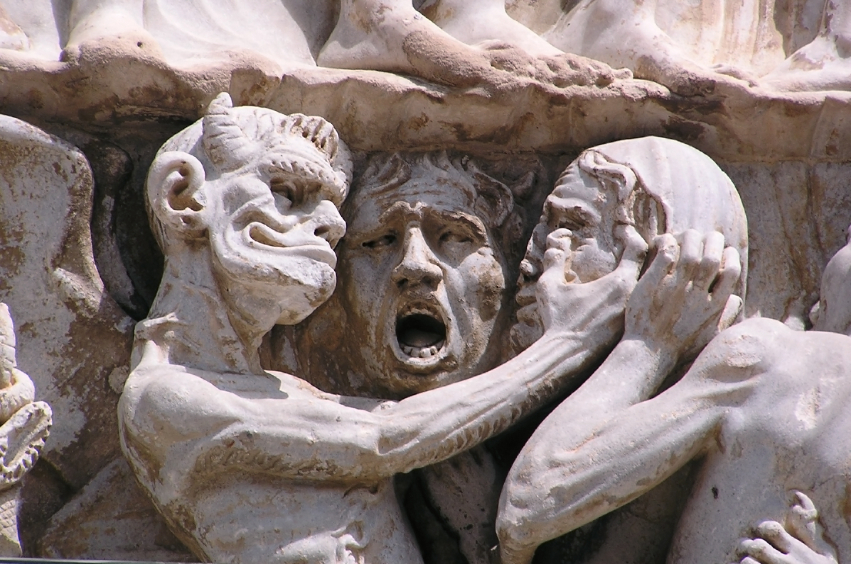
The Marcial Maciel affair forces us to confront the question of evil. Our era avoids engaging with it. What do we know of the devil's work, and what can we do to protect ourselves from it? After attempting to conceal the good in life, should we be surprised that evil is now revealed? The works of the devil are countless, but the Holy Spirit can do all things, including transforming them.
It took the eloquence of Léon Bloy to declare, "There is only one sadness, that of not being a saint." This persistent question of holiness returns like a season that never ends. There are many things we can rid ourselves of, but the question of holiness is never one of them. It is consubstantial with us. As soon as we see or witness something just or unjust, something pertaining to good or evil, we are walking the path of holiness, whether toward it or against it. It takes a long time to realize how consubstantial the question of holiness is with us. We are saints, we are a temple, we came from the Church, which is holy, we are in the image of God, who is holy, and yet we struggle, we fall, we toil, we strive… So little result for so many promises. The fact is that the condition of sainthood requires a great deal of effort and yields few visible results.
“My God, give us priests, give us holy priests…” Faced with the devil’s obvious influence, Maciel, how can we continue to praise the priest’s holiness? Faced with the devil’s obvious influence, how can we continue to praise holiness? But isn’t asking this question already playing into the devil’s hands? For only a man can ask this question and believe he will succeed in answering it. He will believe he is doing something worthwhile, that he will have materialized what always eludes him. This sudden mastery of an inconceivable idea is merely another manifestation of the devil at work through the will to power. There is no understanding of evil by man. No more than there is an understanding of love. Of true love. Of divine love. For man, there is only self-satisfaction. All of this is so far beyond our grasp. We see holiness as a decoration, a recognition. We continue to think backwards. It's not about what God will do to thank us for following his instructions. It's about asking ourselves what we can do to thank God for his blessings. For example, during the liturgy, the priest says, "Quid retribuam" (What is
the reward?). The human temptation is the desire to reduce everything to ourselves. To earthly things. In a mundane way. And that's precisely the problem. The two great forces that guide the universe do not belong to this world. Marc Favreau's reaction perfectly summarized what a person can feel when they feel betrayed, wounded in their faith, especially by the very people responsible for protecting it. Isn't it loving priests too much, isn't it a fundamental mistake to declare them saints? After all, they are only human. They suffer from the same afflictions as we do. In this article, Marc Favreau was giving voice to a legitimate feeling of outrage. Why, how can we allow a priest to believe he is a saint when he sins like everyone else? Far more than average, in the case of Marcial Maciel. Where is the corruption? In the formula? "Give us holy priests?" Is there fraud? Are we being deceived? Are all the priests of the world discredited by Maciel's demonism? The questions collide. There is no victim mentality, so prevalent in our time. If any institution is disfigured, if it acts in the wrong direction, if it is discredited by crime, how can such an institution still represent me?
The questioning of sainthood comes from humanity. Because humanity questions everything, all the time. It's in our DNA. And if humanity questions, it lowers the stakes. It de-hierarchizes. It begins to think for itself. After the apple, discord. It speaks mainly of what it doesn't know. He speaks, and that is enough to make him lose touch with God. Therefore, the question is illegitimate, but it is "human" in the sense that common sense dictates. To say that it is human means that it can be asked to allow humankind to access what it calls knowledge, knowing that it will always be limited knowledge.
Is the institution to be lauded at the advent of a Saint Augustine and condemned at the discovery of a Marcial Maciel? Let there be no mistake: "Give us holy priests" is a cry for help from humanity to God; "Give us holy priests" does not mean give us irreproachable priests. That would be too easy. Give us irreproachable priests and I will believe without question. It is still an act of acknowledgment of one of the human failings most strongly condemned by Christ. Give us holy priests means: give us priests who respect life and the Creator. The priest is a besieged citadel. The Church is a besieged citadel. The apocalypse is underway. To deny it, to forget it, to laugh at it, is to play into the hands of the devil. Every relativist is an agent of the devil, often without even realizing it. Respect for the Creator has almost disappeared. Respect for life is trampled on every day.
“I believe in the one, holy, and apostolic Church.” Our creed, in its astonishing conciseness, constantly reminds us that the Church is holy. Or again: “Do not weep if you love me. If you knew what the gift of God is and what heaven is! If you could hear from here the song of the angels and see me in their midst! If you could see unfolding before your eyes the eternal horizons and fields, the new paths where I walk! If for a moment you could contemplate, as I do, the beauty before which all other beauties pale.” (St. Augustine). Let us remember that Jesus knows Peter’s weakness before Peter does. Does this prevent him from entrusting him with a soul? Faced with Peter’s emotional fervor, Jesus reaffirms his human weakness. While Peter desires immediate recognition, to go with Christ, to follow him everywhere, to decide him now irrevocably, Christ urges him to wait. Waiting versus exaltation. Do you love me? I will give my life for you. Do you truly love me? With all the subtle Greek nuances of the verb "to love" (3rd article on agape). Peter desires immediate recognition. He wants Christ to tell him everything right away. He wants it to be visible. He wants it to be ostentatious. He wants it to be established. Recognition—man is suffocating from this need for recognition that God doesn't necessarily give him. The Devil, on the other hand, gives immediate recognition. Power. Expectation versus exaltation. What is this holiness? What is God's will? What does He want from us? The Church is holy because it comes from Jesus, and Jesus is the door, the only door to God. The Church is holy because it comes from God. "Jesus Christ and the Church, it seems to me, are all one." (Saint Joan of Arc).
Holiness does not prevent defilement, it cleanses it. Holiness does not prevent falling, it lifts us up. Holiness is not the eradication of disease, it is its cure. How many diseases are known to humankind without their origin being known? Holiness is the possibility of elevation. Holiness does not eradicate evil, it defends us against its power. It compels us to look upward, it urges us to escape the grip of evil. Holiness has weapons: beauty, goodness, and virtue. Holiness was not instituted for the strong and the brave; it seeks to be that ever-shining beacon for those who are slipping into misery. Worse still: holiness is not justice. How can humanity cope with this quality that is not truly a quality? Humanity craves the mundane, the concrete, the immediate, the pragmatic. He wants the wicked to pay, for evil to be punished. Holiness delivers no justice. Not: what will the Lord give me for having done good, but what shall I render to the Lord for all his blessings? We see that as soon as we think we have made enough effort to believe, we must climb another rung. A new spiritual supplement. Like a summary of holiness. Of this small holiness, this gentle holiness, which man can gather in his hands to tame, but which does not respond when called upon. This small holiness that seems insignificant, that appears so harmless, that does not intervene, that does not play the expected role… Where does it stand? Is it even reasonable? Can we trust it? This damn holiness did not protect us from Marcial Maciel. She left us prey to our demons, empty, dwelling on the legend of this demon and his legacy, this legion of Christ. How can we restore life to what has been ravaged? How can we find hope again? Holiness has done nothing, the Church has been unable to do anything, the demon has invited himself in, clothed in the holy garments of the priesthood.
Modern man doubts good. He prefers to dwell on evil. He has a taste for defilement that embodies his era. It allows him to assert that defilement is everywhere. It is a penchant for renunciation. It allows him to absolve himself of everything. Only the individual counts, therefore he is absolved of responsibility. The individual has transformed into a voyeur of existence. This taste for defilement is a renunciation of life. The modern era demands that nothing be hidden. Everything must be exposed in the pursuit of transparency; there is a kind of will to purification at work. To show everything and believe one has said everything. Obviously, any person with their basic faculties sees this as a headlong rush. A desire to wallow in defilement, relying on its universal nature. Defilement is everywhere, which is far from being the case for good. Defilement is therefore more universal than good. The absence of good becomes so glaringly apparent. What's the point of continuing to refer to it? Goodness no longer speaks to people. The insane idea, with its own trail of absence and omnipresence of defilement, has imposed the notion that no one can claim to represent goodness anymore. That anyone who declares themselves a spokesperson for good is an imposter. The most condemned, of course, are religious figures and Catholics, seen as moralists, troublemakers. This religion, embodying an old order, giving lessons, wallowing so much in the mire… It is not only discredited, but it should disappear altogether. The modern world ignores goodness, opposing it with defilement. The slightest stain, the slightest misdeed, renders history obsolete. Modern man has learned to distrust good so thoroughly, opinion groups, such as the media, confusing information with desire, have shown him so thoroughly that good is a jumble that, in essence, never truly existed, that it has become so easy to demonstrate its unfounded nature by pointing to evil that the matter is settled. Only defilement is universal. Defilement is universal because it is universally shared. It has become a lingua franca. This complicity with defilement is a delusion. The modern world is fond of this kind of easy allegiance; it immediately allows for an assertion of power. A reality TV show offers instant gratification; the participants so often embody stupidity, the cretinism of not judging them. Power reveals human weakness because it is immediate, swift as lightning; it offers the immediacy that the times demand, it possesses the simplicity to become universal. But man omits an important point, and no one could blame him for it: he omits that good and evil are not of this world. They operate in the world, but they are beyond human reach. Since evil does not belong to this world, there can be no justice concerning it. To evil, to true evil, no human response can satisfy. There can be no justice concerning it. It cannot be repaired. Holiness is the beacon that guides us away from evil. It can do nothing against the evil committed. But it elevates us. It keeps our heads above water. Everything is a little lighter to bear in its presence. Modern man has turned away from life. He has forgotten its foundations. To believe that life can escape evil is to forget what life is. Life created by God. Life blending the natural and the supernatural. Life full of ubiquity. God is everywhere, all the time. But so is evil. The devil invites himself in, adorned in the most diverse and varied guises. To attack holiness is to open the door to the devil. It is a human way of acquiescing to evil. To all those who slam the door on holiness, let us hope that they never have to hold the door shut against the devil; they will be powerless. Prayer slowly builds a bulwark of holiness; the absence of prayer draws humanity closer to its misery. Monastic life has patiently built bulwarks for humanity for centuries. If holiness has weapons and a bulwark, evil constantly blurs all boundaries, all hope, all certainty. Evil is nothing other than this mist. But what a mist! Resembling a breach in the world, it seizes modern man and makes him see mountains and marvels. The prey is so easy, so little inner life nourishes it… Beyond this border, nothing makes sense anymore, everything is turned upside down, no description could recount what cannot be defined. The greatest writers, when they address evil, cannot describe it; they describe fear, they describe what is earthly, they cannot speak of evil. (4. Joseph Conrad. Excerpt from Heart of Darkness) The figure of Maciel is reminiscent of Kurtz from "Heart of Darkness," a demonic figure relying solely on power, a source of acute intoxication.
So? Who was Marcial Maciel? How does he undermine the image of the saint? For any conscious person (what is a person conscious of if not good and evil?), there is a step to take that heralds vertigo. The conscious person is precisely the one who refuses to see the abyss. They do not grasp it. They cannot grasp it, for the void would suck them in; the void is temptation in its splendor. To approach, to look at the abyss is already to succumb to its temptation. Unlike God, evil can absolutely be seen in one's lifetime. That is even what it desires. To ensnare us. Some prey is easier than others. Solitary people are often ideal prey. Solitude makes one fragile, manipulable; it provokes discord. The destruction of everything that creates bonds between people will always be one of its major objectives. Marcial Maciel, whom we now know had been working in the shadows for a very long time, did he feel alone? At what point did Maciel encounter evil? We would like to know. We would like to unravel the mystery. We would expose ourselves to the malevolent power that bewitched him. It is tempting to know at what moment Marcial Maciel looked the devil in the face? This fateful moment is unknown, unknown, and will never be known. Perhaps Maciel himself had buried it, forgotten it, or perhaps, on the contrary—and this is not contradictory—did he desperately seek it to relive its full intensity? The fact that he felt no regret at the end of his life offers no proof of his state of mind. Was he the embodiment of evil, a minister of the devil, within the Church of God, or, as has been said, a victim of a split personality, forgetting his actions as they appeared? His end, if it was indeed as described, cynical and callous, then he was surely a minister of the devil. To even mention him, to speak of Maciel's intimacy with the devil, is already to partake of that intimacy. The devil has so many charms at his disposal. The cult of Maciel's personality, in opposition to humility (the cement of the bulwark of holiness), speaks in favor of the demon. How dizzying it is to see Maciel kiss the papal ring, converse with Pope John Paul II, our bewitched, troubled, and confused saintly pope. When we listed all of Maciel's misdeeds, we said nothing. We spoke of morality. Morality is everything and nothing at the same time. It is everything because it summarizes the crimes and explains the transgression. It is nothing because it has not begun to lift the outer layer of the human heart. Morality never looks directly at someone. It refuses to be dizzy. It cannot be grasped. It is based on justice. It is not concerned with the will to power, only with results. Morality is, in fact, a statistician. Much to the chagrin of many, morality is pragmatic. Which means that it omits the human element. The human element would take it too far. The human response to evil is… human. All too human.
We began with a human situation, with humanity itself. Marcial Maciel, a young seminarian, demonstrates an aptitude for using his talents. From the seminary onward, does Maciel take to manipulating others, perceiving what pleases them, what resonates with them? Is he like this from the very beginning, and what beginning are we talking about? Did he, as a child, have breakfast with the Devil? Did he begin to unravel the threads of evil at the seminary? The testimonies here and elsewhere remain a drop in the ocean of evil. Testimonies often serve justice, morality. All this human chaos explains nothing, for it seeks to represent the totality. What believer has not suffered from the stubbornness of a bad idea, an idea of evil? Who has not been overcome by a will to power, a will to violence, in a moment of calm, a moment that would normally have called for bliss? Who hasn't greeted a sermon with a direct gaze? Who hasn't been intoxicated by its power? To greet is to open the door to the devil. It's to sever our relationship with God. The human mind knows nothing of its own detours. It knows almost nothing of itself. This is how it can escape itself. The usefulness of the dam becomes clearer. When Maciel's personality is discussed, drugs are omnipresent. This argument helps us understand the hold evil has on his personality. It's naive to explain Marcial Maciel's actions by morphine doses. The morphine doses are a pretext here. They surely allow Maciel to recapture some of the intoxication of evil when the Prince of this World is preoccupied with other matters. Did Maciel cross the line the day he sexually tortured another seminarian, succumbing to power over joy? Thinking about evil on earth always leads to a distorted, superficial judgment. This is precisely how victims feel wronged.
Like certain illnesses, evil acts within a person, and it's difficult to say why it manifests. Seeking reasons is tantamount to finding scapegoats. Childhood and society, among other things, are held up as the main culprits. Yet, society merely reveals what lies dormant. And let's not forget that society judges itself, which often comes across as unspoken resentment. By considering society as the source of the problem, it's easy to project all sorts of fantasies onto it. Human beings constantly carry the weight of possibility, and that's precisely what burdens them: they find their freedom in possibility, in the choices they use to shape their lives. No one decides for them. To suggest that society can influence them is an ideology. Society is not to blame. It is individuals who choose the easy way out. And it is here that the reductio ab absurdum takes place. Our era is so fond of it. Because good is too distant, too far away, too unattainable, good as a value is replaced by labels, a fig leaf for moralism, allowing us to find a kinship in the prevailing humanism, this hybrid refuge concealing all the misery of the times: racism represents this new standard value, so simple, so smooth, so easy to describe. Nothing to do with the good whose atonality was exasperating. Racism is tangible. Unfortunately, if we describe racism, or rather the racist, we only scratch the surface of evil. By removing good from our vocabulary, by omitting the depth of what it forced us to grasp, evil has become commonplace. And that is exactly what it wanted. There are no more saints, only men drifting here and there, dispensing petty deals among friends, petty deals with life. Since the end of the Middle Ages, there has been a perpetual quest to replace the transcendent with the immanent. Any attempt to remedy this has been thwarted.
Antiquity taught us that evil can arise from good. Antiquity called this process tragedy. Evil can arise from good, granted. But what about the opposite? Let's recall the facts: Marcial Maciel meets the devil, decides to act while wearing priestly robes (which proves he is not ill), brutalizes, rapes, abducts men, women, and children; it is impossible to have a precise count of his victims. Anyone conscious in Maciel's presence must have felt the sweat beading on their skin. If they knew. And the devil excels at making us believe we know when we forget the essentials. The devil is a playwright. To believe in holiness is to believe in the devil. It is to believe that there is life before evil, and that there is life after evil. To say that good arises from evil, to say that evil arises from good, is to admit an eternal struggle within humankind. To admit this agonism is to recognize that a man is judged as much by his fruits as by his roots.
It is terrible to have to admit that Marcial Maciel, this man who has defiled everything in his life, who has defiled communion, his habit, his office, whose soul has swollen itself, it is therefore difficult, not to say terrible, to admit that the Legion of Christ is a success. Because the devil, as usual, found himself with a formidable task, he found himself facing the Holy Spirit, who never ceases to breathe life into the flames and who has turned green the buds crimson with the proximity of Hell. The devil only wins if life is extinguished. The Holy Spirit never ceases to fan the embers of life. Let life cease, and the Prince of this world will have won. That is how he wins in vengeance. That is how suppressing the Legion of Christ, reviewing it to condemn and stone it, would play into the hands of the evil one. On the contrary, each new offshoot of the Legion of Christ responds scathingly to the infamy of evil. For life goes on.

Leave a comment