
Antoine is no more. He passed away on Good Friday, April 22, 2011. He is in the house of the Father. Antoine was Antoine Lecerf, Lieutenant General Antoine Lecerf. A master of war, a brilliant leader of men, one of the most extraordinary men I have ever known.
When you first met Antoine Lecerf, there was that frank and firm handshake, but there was something else immediately; something akin to charisma. Antoine Lecerf could have charmed snakes. He would shake your hand, and instantly, you were under his spell. He wanted to know right away if you were with him, if you were ready, if you were on board with his plan. What plan? He had a new one every five minutes. And he never abandoned any of them. He thought fast, but his friendships lasted a long time. He wanted to know if you were with him, and he had a surefire way of knowing: he would shake your hand, hold it, his face would come close to yours, he would come to meet you, he wanted to know. He shook your hand, held it, his face drew near to yours, and he slightly narrowed his left eyelid as if to sharpen his vision, as if to be absolutely certain of what he was about to see, of what you were about to reveal to him. His narrowed eye, that penetrating gaze, was searching for something. He was searching for that little spark. He wanted to know if you, too, were alive. Antoine Lecerf only associated with people who were alive. Nothing interested him more than knowing if you were, or even to a lesser degree, if you could be (which was enough to satisfy him, for potential held a very special value for him). Antoine Lecerf chose you. And nothing could be less a matter of chance.
 Antoine Lecerf also had this very particular way of speaking. As I said, ideas flowed freely from him. His mind couldn't tolerate any comfort. Ideas would burst forth, and as if he knew in advance that he wouldn't be able to say everything, that it would be impossible for him to accomplish everything, that time would run out, he would also slightly crease the left side of his mouth. He was making an effort, holding back the excess energy, building a dam that allowed him to sort, select, refine, and polish. Some would call it impatience. There was impatience in him. But an impatience he inflicted upon himself. Not the kind of impatience unbearable to others. No. A completely controlled impatience, which he molded at will to express only its essence, its core, what seemed essential to him.
I met Antoine Lecerf when I was 23. I was a very young second lieutenant, not quite weaned yet. I was arriving at one of the finest regiments in the world: the 2nd Foreign Infantry Regiment in Nîmes. Lieutenant Colonel Lecerf was second-in-command. I spoke to him for the first time in the officers' mess. I remember as if it were yesterday what he told me: "If you're here, it's because you deserve it, but now you have to deserve it even more." He was constantly searching for the perfect word. For a soldier, the search for the perfect word involves visualizing a coherent action. It's difficult for a civilian to understand. It's difficult to understand in our time. For Antoine Lecerf, this search was essential, and no matter how mediocre the times unfolded, he yielded nothing to them.
Antoine Lecerf left for the desert during Operation Daguet with Saint-Exupéry's "Citadel" and "The Quran" in his kit. I was still a very young junior officer on the staff of the 6th Light Armored Division under the command of another great leader, Colonel Jean-Claude Lesquer. When Antoine Lecerf returned from Daguet, I was wearing the green beret. I had been transferred to the 2nd Foreign Infantry Regiment and had been working behind the scenes with the formidable Captain Benoît Toulin of the 1st Company, preparing the performance we wanted to give for the city of Nîmes, in gratitude for his unwavering support. I had written and read a long text that accompanied the Regiment's entry into the city. Antoine Lecerf mentioned it to me two or three times afterward. The text began with these words: “It is men who make history, but it is history that gives them their strength.” He always wanted to dig deeper. To understand a new idea. To approach the sentence from another angle. He was driven by a desire for perfectionism. We spoke again months later when I visited him at the minister's office where he was stationed. He asked me how I had come up with this outlandish idea that history didn't exist because it was constantly being written. And I replied that I had put myself in the shoes of our beloved legionnaires to write it. They, who never dwelled on any of their exploits, and yet most of them deserved a mausoleum! , Lieutenant Colonel Bruno Germain, had found us. We had talked about the past, of course, since time had passed.
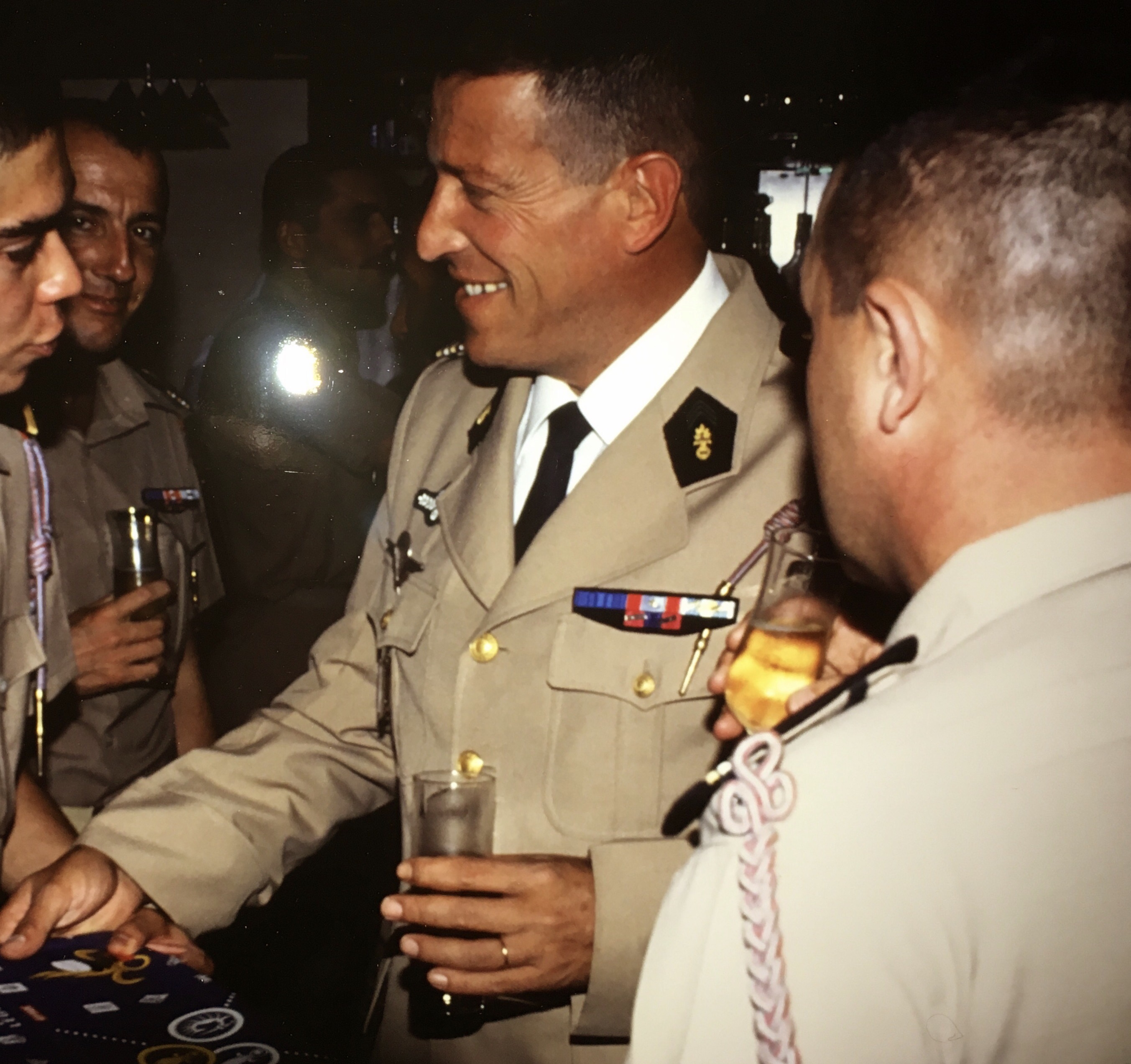 Antoine Lecerf could also give you a sharp rebuke for no reason at all. Many people received a rude awakening this way, without any warning. It took me some time to understand this attitude, which, even if it wasn't frequent, was unexpected and left one perplexed. Antoine Lecerf could therefore sometimes seem a little unfair. He was simply pointing out something within you that you hadn't yet become aware of. The flickering of a small flame. He saw a world that was cracking and immediately, forcefully, remedied it. There was no room for mediocrity to creep in.
Years later, I remember Antoine Lecerf at a dinner with entrepreneurs and industrialists, being teased by the guests—the height of irony!—by a former captain fascinated by civilian life and its trappings. I remember this former officer delighting in the somewhat uptight "military" conversation, a bit stiff and consumerist. Lecerf remained extremely courteous, quickly understanding that the guests present couldn't even begin to grasp the realities of the military. Antoine Lecerf was there to bear witness to the lives of ordinary soldiers, or, more precisely, he was there to bear witness to life among ordinary soldiers. Antoine knew that only values gave meaning to life, that only values could unite men and give them that extra spark that allows them to achieve great things. He also knew that the times were closed to this idea.
Antoine Lecerf loved life, youth, the vibrancy of youth. When he was still a lieutenant colonel, he honored the word "lieutenant" in his rank. Even though it's a rule that lieutenant colonels pride themselves on holding both ranks, he alone, to my knowledge, could truly claim this distinction. And from everything I've read or heard about Antoine Lecerf throughout his career, he always retained this sense of duty, this lieutenant's manner, close to his men, easy to get along with, and always seeking to improve the military condition. Among the lieutenants, he was nicknamed "the ladle" because he always added another ladleful of tasks. If you crossed paths with him or if he summoned you, you were sure to leave with your bag full of innovative ideas… There was always a need to do more and better, and for him, the lieutenants were the bulwark against weariness.
I won't reiterate here the strength of Antoine Lecerf's convictions. We've all read about his impassioned speeches on the training of military officers , on the treatment of the French flag at a contemporary art exhibition… Antoine Lecerf didn't mince words, he created a captivating dynamic, he embodied respect. Antoine Lecerf was unique and authentic. Who else but him could have declared: “Why does a young Frenchman die in Afghanistan? France, the tricolor flag, no, nonsense! He dies for his buddy, his sergeant, his lieutenant, his colonel. Why? Because when you face death every day, a sacred bond is forged. It's simply called love.” He leaves a beautiful legacy for any young person who wishes to pursue a military career, because he undeniably represents a figure: the figure of the French officer. He belonged to this tradition. He is one of those who embody it forever. Ernst Jünger wrote: "We have been given the privilege of living in the invisible rays of profound feeling; this will remain our inestimable privilege." I have been given the privilege of serving in the shadow of Antoine Lecerf; this will remain an inestimable privilege. Rest in peace, General.
- In September 1991, the 2nd Foreign Infantry Regiment returned from Saudi Arabia, where, as part of the Rapid Action Force, it had successfully completed Operation Daguet. Within the 1st Combat Company, which remained at the rear base, I was tasked with writing and directing a show to celebrate this return and the 150th anniversary of the Battle of El Moungar . Ernst Jünger was invited to this show, which incorporated many passages from his books, and he even considered him a virtual character in the performance, called the Ferryman . This show, which attracted more than 10,000 spectators in Nîmes, began with these words, chanted by Richard Bohringer, who had participated in the show out of love for the Legion: "There is no, there will never be, a history of the Foreign Legion; it is made every day that God creates. "


Reply to de Kermenguy Cancel reply.