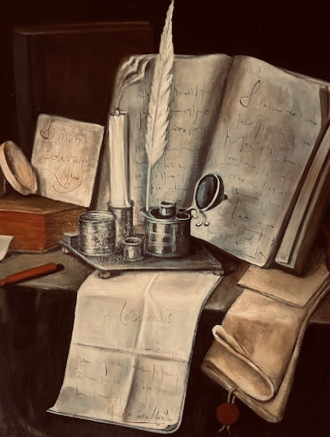
A simple phrase is enough to shake an inner life: " Why do I write ?" A certainty takes shape, paradoxical and burning: writing is pointless, and perhaps that is precisely why we write. Writing becomes a place of unification, even to the point of making oneself a nation.
"Why do I write?" This seemingly innocuous phrase, to which I am asked to respond—neither a question nor an exclamation—challenges my certainties. It questions one of my fundamental beliefs that I am unaware of. It destabilizes my foundations. It compels me to be authentic.
Do we question ourselves when we affirm our sincerity? We believe it, we affirm it. But are we truly sincere? If I have to explain why I write, will I be sincere? Am I capable of assessing my own authenticity when I question it as if it were something foreign to me?
The more I tried to understand the issue, the more a refrain, designed to distract me, occupied my mind and repeated: "Writing is useless, writing is pointless."
Writing to keep myself silent
Why, since the beginning of the world, have men strived to leave traces of their thoughts on cave walls, on parchments, in digital writing?
Perhaps because he who has given life to characters from his imagination, who has run aground on unknown and sublime shores, who has inhabited his inner life much denser than his external, everyday life, knows that writing regulates the course of the sun and the moon.
Just as "man infinitely surpasses man", the world I carry within me always surpasses the world in which I live.
It is so easy to answer the question "why do I write?" with a deafening silence: "I write to keep myself silent!"
I no longer want to listen to myself as a wordsmith, as when I am part of the world. When I write, the noise of the world fades away. The useful gives way to the necessary.
I rediscover that silence where, from the rustling of my thoughts, an intensity is born, ever to be discovered. It allows me to approach those shores that no intelligence, not even artificial, will ever be able to create.
Walcott's Epiphany
One blessed day, while I was not looking for anything, I sat down to read a poet I didn't know. Turning a page, he presented me with an epiphany:
"I am just a red Negro who loves the sea, I received a solid colonial education, I have Dutch, Negro, and English in me. Either I am nobody, or I am a nation."
Wonder arises from both reading and writing. Why do I want to imitate the poet? Couldn't I be content with simply reading his work? Literature allows for a relationship with oneself that is an invitation to the other, the reader who will enter my world.
Here, then, is the trace of my desire: to establish a coincidence of myself with myself.
In his odyssey, Walcott details his multiple origins in order to unify them so as not to become nobody. Ulysses wandered on the waves and in remote lands as nobody, until that dinner at King Alcinous's where he found himself face to face with the troubadour who told him his own posthumous story; while he truly lived, he had become nobody.
That day I understood that writing was akin to alchemy. The poet transmuted life into poetry. Prompters spent their lives trying out formulas. What drove them: the search.
Spending one's days searching, exploring new materials, new combinations. Exploring is exploring oneself. What a marvel it is to dedicate one's life to one's desires, no longer subordinating it to fleeting pleasures, but simply searching, tirelessly, for one's own good, for the hunger of self.
I understood that without literature, I would lose myself. I had touched, deep within myself, for the first time, something that defined me. I realized that the union of my roots would reveal my individuality. Literature asked me to unify the parts that thundered within me.
I had to compose, to assemble, searching for meaning in all this magma, resigning myself to becoming who I am. My assemblage would surpass my diverse origins in every way, just as the poet had shown me the way. My identity would encompass my origins.
This is the nation to which Walcott encouraged me: not to become a super red Negro, or a super Dutchman, or a super Englishman who would each want to take revenge on each other, but a mutual respect founding a new singular being.
To be a nation
Beneath my pen, the path takes shape: winding, steep, and majestic. The diversity within me collides with my pen in order to exist and to survive. I answer my own question by writing.
I am but a dignified Breton, tacking across a sea colored and bewitched by the volcanic Caribbean. My upbringing is also colonial—aren't they all, for that matter? Rome lives on in my veins, mingling with the Greek and Jewish currents that temper and enrich it with their philosophy and spirituality…
I cannot hate anything, for everything reveals me. I must admit everything, accept everything, refuse nothing, and above all, not judge. I force myself to overcome my contradictions without denying or despising them. I embrace my flaws, my shortcomings, and am not satisfied with any anachronistic or base opinion.
I am forging the moral values that will teach me to act, and not just to react, because otherwise I would lose myself again and become nobody.
I am all of that, and even more, when, through my writing, I unite the singular and the universal. Why do I write, if not to establish a bond of friendship between my origins in a true calling? Why do I write, if not to soothe and revitalize my soul, so that it is not held hostage by my contradictions? Why do I write, if not to welcome every other, as I have welcomed all my ancestries?.
When I write, I put down on paper this silence within me that contains the entire universe. It is there that I become what I am. There that I am a nation.
Learn more about Against the Robots
Subscribe to get the latest posts sent to your email.
