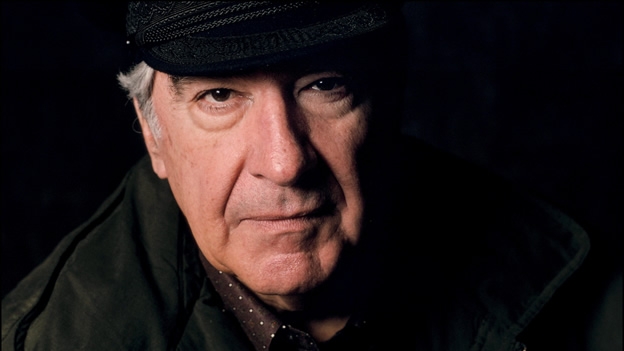
One day in the 1990s, we were walking down the street, having just left the Hôtel des Saints-Pères, when Alvaro Mutis abruptly . We were almost at the corner of Rue de Grenelle, and he said to me, "Emmanuel, I have the feeling we walked like this together a long time ago on a street in Cádiz. And we were having the same conversation." I confess I no longer remember what we said. I'm certain that if Alvaro Mutis were still alive, he would remember.
Alvaro Mutis had a unique relationship with life. He lived by manipulating memory and immediate reality. He always had one foot in one and one foot in the other. For him, these two worlds were inseparable; they were close, moving in tandem, like Siamese twins, like a one-way street, for the better. Alvaro Mutis lived his life and other lives, lives he had lived before, or would live later. Above all, Alvaro Mutis lived, at all times, accompanied by a young boy, this still-child named Alvarito, who was at all our gatherings. Carmen, Alvaro's wife, accepted his presence even though he wasn't her son. I have never met anyone like Alvaro Mutis. I mean, his presence, his childlike presence next to the same adult of a certain age, had something terrifying and intriguing about it. I told him this often. I told him that Bernanos, whom he loved, must also have lived in this way with the embodied remnant of his youth at his side.
I've come here to share what I know of Alvaro Mutis, Maqroll el Gaviero, and a few others… These last few years have been slow and long. We corresponded much less. He no longer wrote. He hadn't written for so long. Tremors had taken hold. A certain emptiness, too. Everything was destined to disappear, like the stump of a dead tree that vanished in a week in the humid furnace of South America. Everything had to pass, and this spectacle of life in action never ceased to amaze Alvaro Mutis throughout the ninety years he spent on this earth.
What can I say about him? Walking the streets of Paris alongside Alvaro Mutis was like stepping back in time, reliving the Paris of Henri VI, the Paris of Louis XIV, the Paris of his childhood, a city that encompassed all eras. A few steps were enough to make us believe we had indeed witnessed this scene in a street in Cadiz or Constantinople centuries before. Alvaro Mutis, with his strong, resonant voice, spoke of life, having lived it deeply. One might think that life cannot be recounted. But when Alvaro Mutis spoke, he lived. He possessed that unique, boundless talent for living and reflecting on life. And so, he lived with this young man, right beside him. And so, in the middle of the Luxembourg Gardens, he transported us in minutes to the sun-drenched lands, and Maria, the young coffee picker, came to meet us. We leaned against the family hacienda in Coello, in Tolima. The warm soil of Colombia. The omnipresent plantations. And in the blink of an eye, in a few minutes, we found ourselves strolling through the streets of Bruges, Antwerp, or on a raft going up the Mississippi.
How many times did Alvaro Mutis want to be done with Maqroll el Gaviero? The topman, his sort of adventurer and globetrotter alter ego, was embodied in poetry. One day, Alvaro Mutis decided to give his hero a new life. One day, somewhat against his will, he shed the armor of a great South American poet to become a prose writer. But that wasn't his greatest challenge. His greatest challenge was exposing Maqroll to prose, offering him this new life, a life that Alvaro thought would be simpler. Would the topman survive the novel that followed the poetry? Alvaro Mutis admitted that he had transformed the poetic Maqroll into a novelistic character to get closer to him; he would only distance himself from him from now on. That was the power of the novel, where a character becomes autonomous, where the character takes on flesh and suddenly lives his own life, which nothing seems able to disturb . “I refuse to accept that what happens to me is imposed by fate in this way. I want to decipher its meaning instantly, to subject it all to my own will, to my own delusion, and then we'll see what happens.” Maqroll el Gaviero, or the embodiment of freedom.
I remember the day I met him again in Saint-Malo at the Étonnants Voyageurs . We hadn't seen each other for a few years, since my first interview for L'Action française, which had given him so much joy—he, the staunch monarchist, speaking to French royalists. I was waiting for him in a packed room, and he entered surrounded by a throng of people, some more official than others. As he passed by, I whispered, "Alvaro, it's Emmanuel." He stopped like a Swiss Guard, and the whole group was taken aback, and we fell into each other's arms. As if we had only parted a few weeks before… What can I say about Alvaro Mutis? There are so many qualities to mention. The most beautiful is also the one he immediately perceived in his interlocutor: nobility of heart.
Alvaro loved the word "despair" immensely. It contains despair, hope, and wandering. It contains possibility. From poems to novels, Alvaro Mutis was a wanderer, and of course, an astonishing traveler. In Saint-Malo, a city of which he had become a pillar and an honorary citizen, so much did he embody the Michel le Bris festival, he gave a lecture of incredible intensity on Simenon, on Belgium, on the king, on literature. Wherever Alvaro spoke, he astonished. Wherever he was read, he captivated. That was Alvaro Mutis. And Maqroll el Gaviero couldn't have done better. Perhaps only in recent years when illness gripped Alvaro. But only at times, when he let his guard down to take care of himself. And then Maqroll was getting older too; since Bergen, he was feeling the strain. I still remember an afternoon spent exploring the spirits, and especially the rums, in my bar. Alvaro was burying his nose in the various nectars of the Caribbean. Alvaro had a passion for the Caribbean. He had translated Édouard Glissant. And there we were, overwhelmed by such a profusion of excellence, and we spent more time smelling the aromas than tasting them. We were listening to Carlos Gardel, Enrique Morente… I wanted him to read a book about General Mihailovic that had come out some time before. I gave him the book. He was a true hero to him, and I thought he would find inspiration for poetry in it.
In everything Alvaro Mutis said, modesty permeated the air. Because Alvaro Mutis knew that only modesty allows for intimacy, he placed it, for himself and for his characters, above all else. It was omnipresent in Maqroll, in Abdul Bashur, in Ilona, in Flora. It was always embodied differently by these characters, different facets of the same quality. It was always about modesty, but expressed with care and skill, and this extreme refinement was enough to distinguish him as a writer.
One day at the Hôtel des Saints-Pères, we shared a delightful moment with Eduardo Garcia Aguilar, whom you had introduced me to, and Françoise Verny, sitting at a neighboring table, joined us, praising you. She loved you so much that she invited me to come see her whenever I wanted. Of course, I never went. And you reproached me for it. I remember you saying to me, "Go see her! What are you waiting for?" I always knew you knew the answer. We shared this acceptance of life, which was also a form of modesty, or at least stemmed from modesty. We shared this acceptance of life… I don't know if this sentence is understandable to everyone. It's about feeling the flow of events like the flow of a river. There are some things we fight against and some things we must accept. It's impossible to navigate without knowing the strength and direction of the wind, without knowing the currents, the sandbanks, the tides. And every sailor knows they must choose their battles. Sometimes they must weather the storm, other times they must confront the Titans… Total acceptance of life has nothing to do with fatalism. It doesn't prevent one from fighting and expending energy for a cause; on the contrary, it absorbs negative energies and allows life to develop without fear or prejudice. A life of long voyages. Despair was also a way of describing this long voyage. It was both the illness and the cure. We speak of a life of trust. Because the young man beside us is never worried about embarking on a new adventure. Because the young man knows that "Poetry is meant to teach men what they are without knowing it."
My dearest Alvaro, you so loved to recount this experience you lived through and described in *The Admiral's Snow *: one day, while walking at Krak des Chevaliers Hospitaliers, you read a short and powerful epitaph on an anonymous tomb: "It was not here." The certainty of this epitaph never ceased to haunt you. Your passing makes me realize that this definition perfectly captures your life. It was not here … I remember precisely that you gave me this definition one foggy morning, very early, in a street in Cádiz; it was August 25, 1472. It was your birthday.
- Alvaro Mutis was considered one of the two greatest Colombian writers, along with Gabriel García Márquez. He died on September 22, 2013. All his poetry and prose works are available from Grasset ↩
- Ernst Jünger, in *The Author and Writing*, recounts that after naming a character in a novel and writing only one page, it becomes impossible to change the character's name without rewriting that page, because the character will have begun to live a life of its own .
- A hero betrayed by his allies by Jean-Christophe Buisson. Perrin Publishers ↩
- Eduardo Garcia Aguilar, a long-time friend of Alvaro Mutis and author of the interview book "Memories and Other Fantasies" published by Éditions Folle Avoine ↩
- In August, a magnificent tribute was paid to Alvaro by Eduardo Garcia Aguilar, Santiago Mutis Duran, Adolfo Castanon, Julio Ramon Ripoll, Pedro Serrano, Fabio Jurado, Fernando Herrera, Consuelo Gaitan, and William Ospina. His friends and son decided to republish Reseñas de los hospitales de Ultramar and to offer him this reissue of one of his first books for his 90th birthday .

Leave a comment