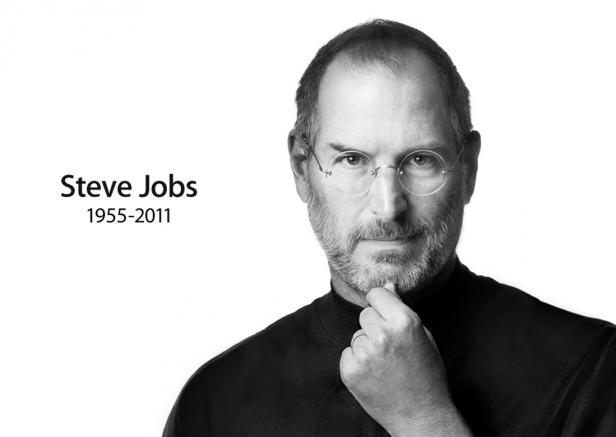
 “Steve Jobs 1955-2011,” read Apple’s website on October 5, 2011. Right to the end, this unique, minimalist, elegant, and effective signature. His signature. The uproar caused by the death of this American business leader took the world by surprise. Soon enough, the comparison was made, as with Lady Diana a few years earlier. Yet the comparison ends there. Lady Diana had come to embody the image of the oppressed in the face of a powerful hierarchy; true or false, this image also indulged in a dream of a broken princess, evocative but without any real connection to reality. Steve Jobs’s death is in no way a matter of the oppressed. Steve Jobs’s death is essentially a matter of intimacy, and therefore of discretion. Steve Jobs’s death resonated with a global impact. Steve Jobs’s life is an ode to intimacy.
What was Steve Jobs thinking in the days leading up to his death? Undoubtedly, his mind was layering images from his childhood onto other childhood images. When the time comes to die, thoughts come and go like waves on the beach. With the same sound, the same intensity, the same mastery, the same expertise. With the same intimacy, too, since the sound of waves is unique to each individual. What childhood thoughts could have been occupying Steve Jobs's mind? At the end of August, when he resigned as CEO of Apple, anyone following Apple news, and even, one might say, consumer computing news, sensed that things were going badly. Worse still. Because since 2004 and the announcement of his cancer, his health, even though repeatedly declared to be in remission, showed no signs of improvement. "Childhood memories are endless and disordered," said Chateaubriand. In his home, surrounded by his family, is Steve Jobs thinking about the moment his biological mother "offered" him to adoptive parents? Or is he imagining the faces of his first adoptive parents? Those furtive first adoptive parents who rejected the baby because they had changed their minds and now wanted a girl. Steve Jobs almost became a lawyer's son, perhaps with a life different from the one he lived. Or perhaps Steve Jobs is trying to feel the joy that overwhelmed his mother when, one early morning, she received that phone call informing her that a little boy was available and that she could have him if she wanted. Perhaps Steve Jobs is retracing the paths of his childhood, those paths where one so often learns the hard way, those where life is a constraint whose burden one longs to be rid of. What does childhood tell us if not of failure? Or rather: what does childhood tell us if not of joy? So many opposing forces clashing. So many opposing forces annihilating each other. Childhood is yin and yang. Childhood is a path where extremes embrace every second. In his home in Palo Alto, California, Steve Jobs lies on his deathbed. He feels he no longer has the strength to get out of it. Much life has fled from his body, which resembles a finely perforated mattress. People who have the time to die are blessed by the gods. Suffering is there, of course. But, deep down, suffering is nothing. Or rather, suffering is irrefutable proof of life still present. What will we do when there is no more suffering? Steve Jobs, like anyone who is about to die and knows this end is imminent, begs suffering to settle in and endure. And why continue to live? Why fight? For many long months, he has known it's over. Since 2004, and the announcement of his cancer, he has seen this guillotine he never imagined before, yet which is so real, right above him, right above his neck, ready to fall, ready to end this great movement, this exaltation, this madness, this joy, this perpetual reinvention, this perfection: life. Life is perfection, life is unique, therefore life is authentic. Steve Jobs knows he hasn't fully unraveled the mystery of life. He knows that the passing of time doesn't offer him any more answers. He knows he loves only one thing: this quest, this search, this path. He would do without all the solutions, all the answers, to continue traversing this path, this endless path that always expands without ever revealing itself. On his deathbed, in his home in Palo Alto, near San Francisco, not far from Apple, Steve Jobs reflected on his life and said to himself that he wished he had lived longer, because he had so loved living his life (1). He believed that this life had been his own and that the intimacy he had cultivated with it was his crown jewel.
Is Steve Jobs's name complete when we've said how he died? Of course not. Death is a snapshot that can illuminate a life, absolve it, give it meaning, but death isn't everything. To think only in terms of death would be to imitate those so many people today who see only the living in life. To live forever is not life. To live forever is a scientist's delusion. Steve Jobs's life was a stream transformed into a river. Mixed-race (2), abandoned, refused, rejected, exposed as an impure and accidental child, Steve Jobs's life began like a waking nightmare. And very quickly, the first constraint: his adoptive parents, those who finally agreed to take him in, were made to condition that this boy go to university. The good conscience of the student mother who wanted a future for the child she couldn't take responsibility for. We see the stream. A trickle of water. A brook. Steve Jobs' life became that of many children from the American middle class. It was the 1970s, and America was discovering the beatniks, the Vietnam War, LSD—artifacts of life. Since no one had taught Steve Jobs about life, since no one could teach him, since he took his first steps in life naked, without even parents to clothe him, without even the affection or love that animals show their young, Steve Jobs would build himself up. He would build himself up alone. An abandoned child is a superhuman. Steve Jobs would become a sponge for life. Life didn't want him, so he would risk an excess of life. No one dies from an excess of life. Early on, faced with abandonment and rejection, Steve Jobs became a champion of abused children. Boris Cyrulnik studied these phenomena under the name of resilience. When these terms were coined, their importance or full meaning wasn't necessarily fully grasped. Steve Jobs begins to enter into this life infinitely larger and deeper than external life: the inner life. "Larger than life," as Americans like to say. The expression is apt. Steve Jobs was traumatized; he will rebuild his inner self. Intimacy, the relationship with oneself. The relationship with one's inner self. It is on this unbreakable bond that Steve Jobs will build his life. Herein lies an explanation for the phenomenon of resilience. A man without a father searches for his unknown father his whole life. A man without love searches for love without recognizing it. Steve Jobs, however, is driven by this life force. He alternates between resilience and enduring presence. This is often the mark of a refined intelligence. He knows that his inner self protects him, and he also knows that it is his strength. Steve Jobs, drawn to the East and the hot meals of Hare Krishna temples, will discover a place that will become the crucible of the Steve Jobs everyone knew: the Tassajara Zen Mountain Center. Overlooking Carmel, in an idyllic setting, Steve Jobs met a man who would change his life: Kobun Chino Otogawa. In this Zen temple, a perfect example of craftsmanship, Steve Jobs, in the lotus position or seiza dachi, absorbed the atmosphere and brought East and West closer together. For hours on end, he deconstructed and reconstructed his inner self. Great mystics know this: from deconstruction arises a form of grace. The constant search for deeper understanding brings about grace. At Tassajara, Steve Jobs discovered craftsmanship, ethics, inner dialogue, Zen aesthetics, a father figure, and a new intimacy. What more could one ask for? For a resilient individual like Steve Jobs, it was the crucible of who he would become. The event that changed the course of his life.
From a violated childhood, a child is born with the feeling of being unique. Of course, every life is unique. But there's a difference between stating it generally and living it. This isn't about ego. It's difficult to say whether Steve Jobs' mixed-race identity played a role in his life. The United States of America has no concept of mixed-race identity. It doesn't name it. It blissfully ignores it. You're either White or Black. Steve Jobs was White, with a Syrian father. Was Steve Jobs aware of his origins? Did he feel Eastern blood flowing in his veins? And what difference did this influx of foreign blood make? No one can say. Human nature is an unfathomable mystery, and what is true for one person is false for another. No two people are ever alike. And since human nature is unfathomable, the contribution of culture to each individual is equally unfathomable and immeasurable. No two effects will have the same cause. No two causes will have the same effects. No alchemy is predictable. Steve Jobs, a child who suffered abuse, rebuilt himself in the mountains overlooking Carmel alongside his "roshi" (master). He joined lines, small strokes—"dots," as they say in English—what educators label "life." He left university and audited typography classes. A few years later, Steve Jobs immersed himself in calligraphy in Tassajara. Calligraphy resembles a map of life. Steve Jobs began to write his own. Those who wrote his entry into life are forgotten; he writes his present. In Tassajara, Steve Jobs obeyed the injunction to live his life. By rebuilding his inner self. By reconnecting with himself, he discovers that his life is unique. And he discovers that he is an authentic being. That's no small thing! How many children, abused from a very young age, are left to struggle or lost in an existential void? It can be very complicated to live. The modern world constantly adds complications to the solutions. Steve Jobs, in Tassajara, rediscovers the meaning of things. Buddhism has had, and still has, this impact in the United States because of the simplicity it brings to the questions that the modern, white world poses and exposes. In Zen Buddhism, Japanese Buddhism, Buddhism, Confucianism, and Shintoism are intertwined. The Japanese character can be understood through this blend, this triptych: faith, ethics, and purity, in a way. What unites these three values is the extraordinary sense of intimacy the Japanese possess, a sensitivity rooted in modesty. Steve Jobs will forever be imbued with Japanese values in Tassajara because he finds an aesthetic of life there.
In 2005, at Stanford University, Steve Jobs delivered a powerful speech that resonated more than ever as a testament. We remember, of course, the phrase "Stay hungry, stay foolish" (3), but what truly crowned that day was the intimacy and restraint of the speech. Steve Jobs recited the diary of his life that day before strangers who would remain strangers to him, in his own words, with his scars, and with his humor. For Steve Jobs, intimacy meant the possibility of existing through the choices one makes. Steve Jobs spent his entire life making decisions, again and again, imposing unwavering standards on those around him because he imposed them on himself. His hatred of dogma (it goes without saying that dogma is contrary to privacy, whether represented by schools, white-collar workers, IT directors, or even geeks who think they're living the revolution because they bypassed a firewall) was always a wellspring from which he drew a little freshness. Yes, Steve Jobs was a rebel, insolent and sometimes pedantic, flying into a rage at the cynicism he had encountered in the early days of his life and which remained his sworn enemy. He knew that cynicism was equivalent to self-love, the love of one's privileges, of one's comfort zone. Steve Jobs relentlessly fought this temptation within himself. Therefore, he fought it in others. Combating white-collar cynicism meant creating a product that white-collar workers worldwide said was impossible to make, and ensuring that product became a universal success. Steve Jobs dreamed of the universal. Steve Jobs dreamed of the universal, as is often the case with people obsessed with authenticity. Steve Jobs used to say, "Design is a funny word. People think design means what something looks like. Design means how something works. The design of the Mac wasn't what it looked like, even though that was part of it. First and foremost, it was how it worked." And also, in a recent interview, he confessed his concern about younger generations who no longer knew how to be bored because of electronic devices. He recalled that it was precisely in those moments of boredom that he had invented these electronic devices. We can clearly see the irony of the modern world, which constantly invents remedies for the new ills it generates.
As he lay breathless on his bed in his Palo Alto home, Steve Jobs reflected on the time between his birth and death. It seemed so short. A life is a snap of the fingers. The time between his death and death was much shorter, yet it felt distant. For two weeks, he had lacked the strength to move. He had met with all his friends. He had searched with them and his family for a way to say goodbye. Steve Jobs reflected that he had been blessed until the very end. He had had time to consider such details. His mind was still full of vivacity. Since this morning, he had been practicing kinhin a hundred times; this Zen walking that wasn't really walking, but which allowed one to understand Ma. Ma: distance, approach to things or people, attention, intensity! Ma is one of those Japanese concepts whose depth is matched only by the difficulty for a Westerner to grasp it. Steve Jobs understands that his entire life has been nothing more than an approach to Ma. He picks up the thread of kinhin in his thoughts. Wasn't his constant drive to develop the user experience, at its core, simply an application of Ma? As the day of his death approaches, Steve Jobs remembers that "the beginner has many possibilities, the expert few." A breath, his last breath, leaves him and traces a few musical notes in space. He only has time to read them. He recognizes them before fading away. They are the notes of Bach's cello suite, performed by Yo-Yo Ma a few days later in the Palo Alto cemetery. A final, intimate tribute.
1- Steve Jobs had these famous and rather surprising words coming from the mouth of a CEO of an American Hi-Tech company: "I would trade all my technology for an afternoon with Socrates.".
2- At first glance, the impact is minimal in the United States, where the very concept of mixed-race doesn't exist. Barack Obama is considered Black. Which is, of course, false; Barack Obama is of pure mixed race. His mother is white and his father is Black. For years, we've been bombarded with talk of mixed-race identity, but the mixed-race person doesn't exist. The mixed-race person is nowhere to be found. The mixed-race person is nowhere to be found. Moreover, this contagion seems to have been definitively adopted by Europe, which finds nothing wrong with the fact that Barack Obama is Black.
3- "Stay hungry, stay foolish." The Stanford speech is available in French at this address: https://youtu.be/x1Z9Ggqr84s (video). At the end of the speech, Steve Jobs says this phrase and explains its origin.

Leave a comment